
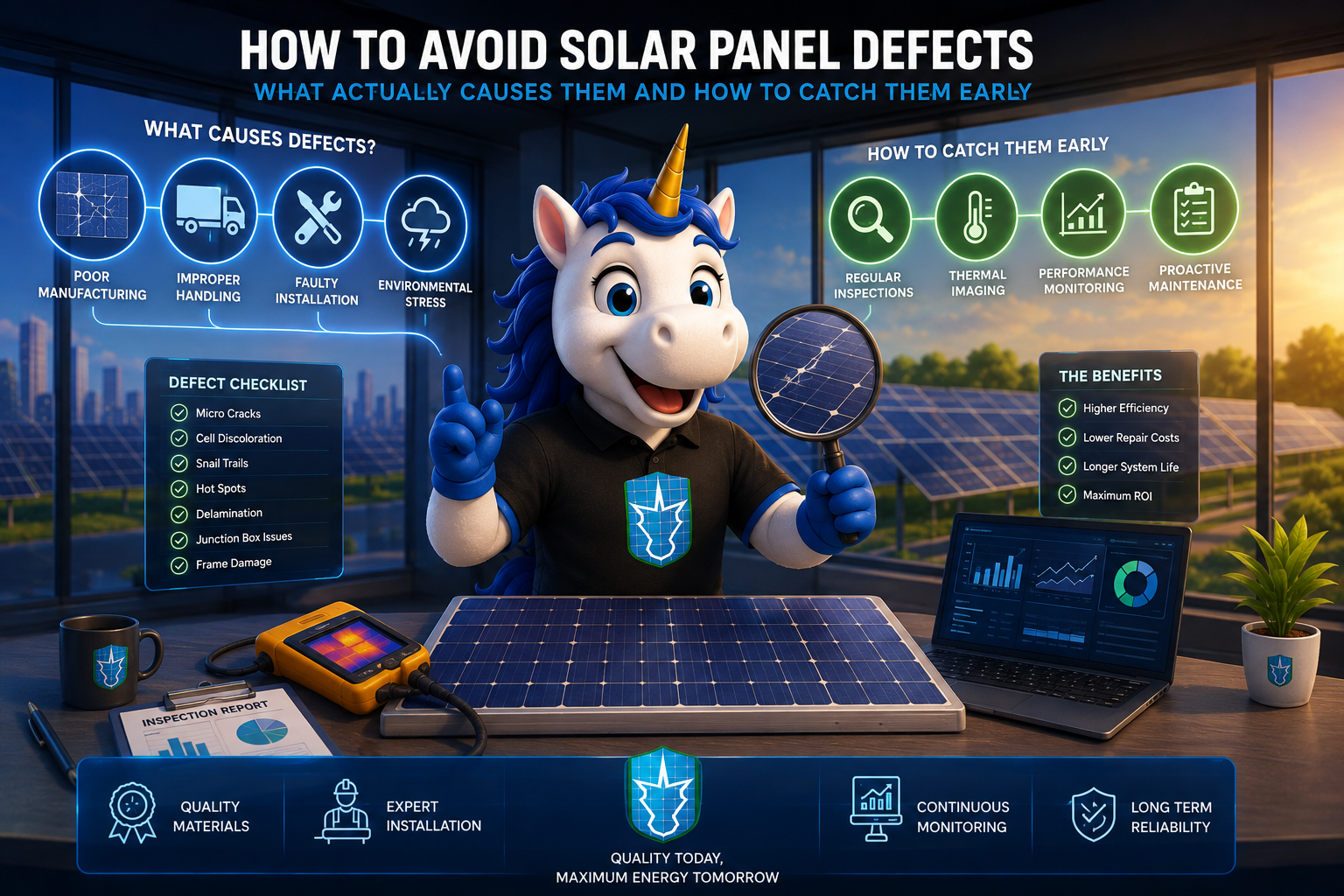
Panel defects usually don’t feel random when you trace them back far enough. A microcrack that shows up on a performance report six months after installation often started with rough handling during shipping. A hot spot on an otherwise healthy array can trace back to a cell mismatch that was never caught before the panel left the factory. Defects have causes, and most of those causes have a specific point where they could have been caught.
That’s genuinely useful, because it means avoiding defects isn’t about hoping for good luck with a manufacturer. It’s about knowing where problems typically originate and putting a check in place at each of those points.
Here’s a practical breakdown of the most common solar panel defects, where they usually come from, and what actually catches them before they become your problem.
Microcracks: The Most Common and Most Overlooked Defect
Microcracks are small fractures in the silicon cell that aren’t visible to the naked eye. They don’t always cause an immediate performance drop, which is exactly why they’re dangerous. A microcrack can slowly worsen over time due to thermal cycling and mechanical stress, eventually leading to a noticeable output loss or a full cell failure.
Where They Usually Come From
Rough handling during transport, dropping or stacking panels incorrectly during storage, and aggressive handling during installation are the most common causes. Manufacturing defects can also introduce microcracks before the panel ever ships.
How to Catch Them
Electroluminescence testing, usually called EL testing, uses a specialized camera to reveal cracks and defects invisible under normal light. Requesting EL testing at the factory before shipment, and again at receiving for large orders, catches most microcracks before they become an installed, harder-to-diagnose problem.
Potential Induced Degradation (PID): A Climate-Specific Risk
PID is a gradual performance loss caused by voltage differences between the solar cells and the grounded frame, made worse by heat and humidity. It’s a bigger risk in hot, humid climates and can significantly reduce output over time if a module isn’t designed to resist it.
Where It Usually Comes From
Not all panels are equally resistant to PID. Some manufacturers build in anti-PID design features, like specific encapsulant materials and cell coatings, while others don’t prioritize this as much, particularly in modules designed primarily for drier climates.
How to Catch It
Ask manufacturers directly whether their modules are PID-resistant and whether they have third-party test data to back that up, especially if your project is in a hot, humid region. This is a design question to ask before purchase, not something you can fix after installation.
Hot Spots: Often a Sign of Cell Mismatch or Shading Issues
Hot spots happen when one cell in a panel produces significantly less current than the rest, forcing it to absorb power instead of generating it, which creates localized heat that can damage the cell and surrounding materials over time.
Where They Usually Come From
Cell mismatch from inconsistent manufacturing quality is one cause. Physical damage, partial shading, or debris covering part of a panel after installation are other common triggers.
How to Catch Them
Infrared thermal imaging during commissioning and periodic maintenance checks can identify hot spots before they cause lasting damage. This is a detection method worth building into your standard commissioning process, not just a reactive check after a performance complaint.
Delamination and Junction Box Failures
Delamination is when the layers of a panel, like the glass, encapsulant, and backsheet, start separating, often due to poor manufacturing bonding or prolonged UV and moisture exposure. Junction box failures happen when the connection point where wiring exits the panel degrades, corrodes, or is not properly sealed.
Where They Usually Come From
Both are typically manufacturing quality issues, though junction box failures can also result from improper installation or exposure to moisture that shouldn’t have gotten in if the seal was done correctly.
How to Catch Them
Visual inspection at receiving can catch obvious manufacturing issues. For junction boxes specifically, checking seal integrity and proper cable routing during installation prevents a lot of field failures that would otherwise show up months later.
A Practical Checklist for Reducing Defect Risk
- Request EL testing documentation before accepting a large shipment, not just a sample
- Confirm PID resistance data for modules going into hot or humid climates
- Train installation crews on proper handling to avoid introducing microcracks
- Run thermal imaging during commissioning to spot hot spots early
- Inspect junction box seals and cable routing as a standard installation step
- Ask manufacturers directly about their factory QC process, not just their warranty terms
Real-World Examples
The transport microcracks. A commercial installer received a shipment that passed visual inspection but showed unusually low output during initial performance testing. EL testing revealed a pattern of microcracks consistent with rough handling during transit, allowing the installer to file a claim before the panels were permanently installed.
The humid climate PID issue. A project in a hot, humid region experienced a gradual output decline over its first two years that traced back to PID, since the modules selected hadn’t been specifically designed or tested for PID resistance in that climate type.
The EL testing catch. A developer receiving a large module order requested EL testing on a sample from each container before accepting the shipment. One container showed a noticeably higher rate of microcracks than the others, allowing the issue to be addressed with the supplier before installation rather than after.
FAQ
What’s the difference between a microcrack and a visible crack?
A microcrack isn’t visible to the naked eye and often doesn’t cause an immediate performance issue, but it can worsen over time. A visible crack is usually more obvious and often causes a more immediate, measurable output drop.
Is EL testing something I can request, or only something manufacturers do internally?
You can request EL testing documentation as part of your purchase agreement, and for large orders, it’s reasonable to ask for testing at receiving as well, not just relying on the manufacturer’s internal process.
Are cheaper panels more likely to have defects?
Not automatically, but price alone doesn’t tell you about a manufacturer’s QC process. It’s a good idea to ask about their defect rates and testing procedures, no matter what the panel costs.
Can defects be fixed after installation, or do panels need to be replaced?
It depends on the defect. Some problems, such as debris causing a hot spot, can often be fixed without needing to replace the panel. Structural issues like significant delamination or advanced microcracking typically require replacement under warranty.
How often should I check for hot spots after installation?
Thermal imaging during commissioning is a good baseline, with periodic checks during routine maintenance afterward, especially for larger commercial and utility-scale systems where undetected issues can affect a meaningful amount of production.
Wrapping Up
Solar panel defects aren’t usually bad luck. They trace back to specific points, whether that’s a manufacturing process, a shipping and handling issue, or an installation practice, and each of those points has a way to catch. My take: The projects that avoid costly defects aren’t the ones that just got lucky with a manufacturer. They’re the ones that built testing and inspection into their process at the right stages, rather than assuming a panel was fine just because it looked okay. If you want a second opinion on quality control before your next equipment order, reach out to Unicorn Solar for a free consultation on testing documentation, manufacturer vetting, and defect prevention.
