
Commercial solar project costs vary widely based on system size, site conditions, and equipment specifications but the return on that investment depends entirely on the company that designs, sources, and installs it. A system that underperforms erases savings that were built into the original project’s return-on-investment projections.
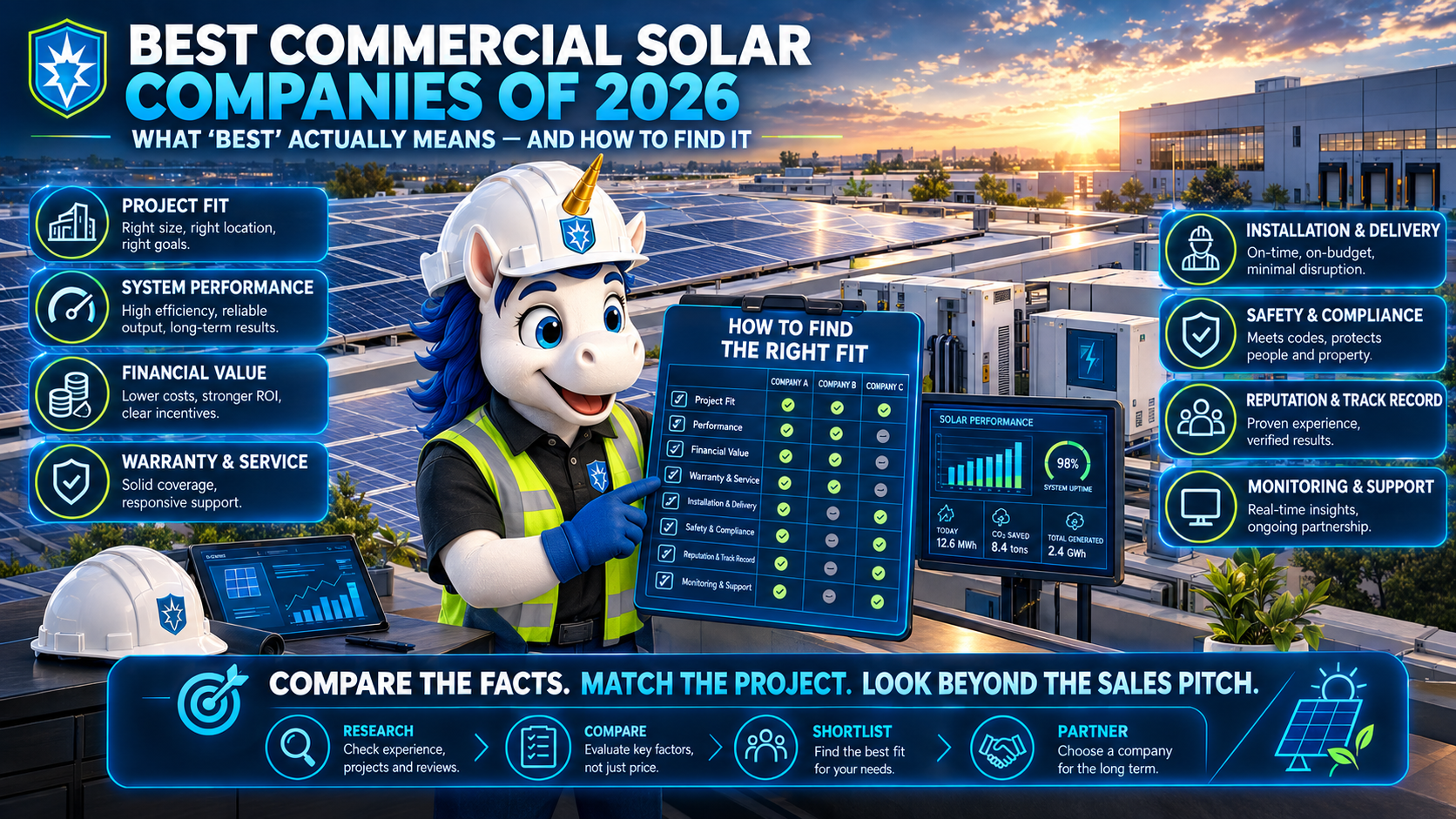
Every list of the best solar companies looks different depending on who published it and what they measured. Some rank by customer reviews. Others rank by size, panel efficiency, or financing options. What rarely gets explained is that “best” is not a single category. The best company for a small business installation is not the same as the best company for a large-scale commercial developer. Understanding what best actually means for your situation is the only way to make a decision that holds up over a 25-year system life.
What “Best” Means in Solar Depends on Your Situation
A best solar company for small commercial projects prioritizes accurate system design, flexible financing, and strong post-installation support. A best company for large-scale commercial or industrial use prioritizes permitting experience, equipment reliability, and project management at scale.
The companies that consistently earn top ratings share traits across all segments: they are transparent about equipment, accountable after installation, and clear about what their warranties actually cover. The ones that underperform usually fall short in at least one of those areas.
Why Choosing the Wrong Company Costs You More Than the Price Difference
A solar system that underperforms by 15% does not just produce less electricity. It extends your payback period, reduces your return on investment, and leaves you paying more for grid power than projected every single month.
The real financial risk is not in paying slightly more for a quality installer. It is in paying market rate for a company that cuts corners on equipment sourcing, misses the system design, or disappears when a warranty issue comes up. Solar panel costs have dropped more than 60% over the past decade. The companies that pass those savings to customers while maintaining quality are worth working with. The ones that pocket the margin and reduce quality are not.
What the Best Solar Companies of 2026 Actually Do Well
They design systems using real site data. Top companies use roof-specific or site-specific measurements, actual shading analysis, and local irradiance data to project realistic energy output. Generic estimates designed to show the most attractive savings number are a sign of a sales-first operation.
They use verified, documented equipment. The best companies tell you exactly which panels and inverters they are using, who manufactures them, and how the warranty works. A company that cannot clearly explain its equipment sourcing is usually buying on price with limited accountability attached.
They handle permitting and interconnection end to end. Interconnection delays are one of the most common sources of project frustration, particularly for larger commercial systems requiring utility coordination. The best installers manage this process themselves, track it proactively, and do not push for final payment before your system is approved and running.
They offer warranties that are written and specific. A workmanship warranty should clearly state what it covers, for how long, and what the claims process looks like. Verbal assurances do not hold up when something goes wrong two years after installation.
They have a verifiable local track record. Brand recognition is not the same as local competence. The companies consistently rated best in any market have completed projects nearby that you can independently verify through references, not just review sites.
Notable Companies Worth Knowing About in 2026
Freedom Solar Power consistently ranks as a top commercial provider built specifically for business-scale projects. Enphase Energy leads microinverter technology and appears in systems from many top-rated installers. First Solar leads US panel manufacturing with a domestic supply chain that removes tariff risk entirely.
How Equipment Sourcing Separates the Best From the Rest
One of the clearest differences between top-rated solar companies and average ones is how seriously they treat the supply chain behind their equipment. The same panel brand can come with full manufacturer warranty support through one channel and no enforceable coverage through another, depending on how and where the equipment was purchased.
The best solar companies source through verified channels and can document it. Installers and developers who want that level of verification without building an in-house procurement team can work with a professional sourcing partner like Unicorn Solar to get the same supply chain accountability the best operators use internally.
Common Mistakes When Choosing a Solar Company
- Picking based on the lowest monthly payment rather than total system cost is where many buyers go wrong. Lease escalators, PPA terms, and buyout clauses can significantly affect long-term value in ways a monthly figure does not show.
- Assuming national brands are safer than local installers is not always accurate. Some national companies use subcontracted installation crews with limited oversight. A well-established local company with a real track record often delivers better accountability.
- Skipping the reference check is the fastest way to get surprised after signing. A conversation with a customer whose system has been running for two or three years tells you more than any review page.
Frequently Asked Questions
What determines the payback period for a commercial solar system in 2026? Payback period depends heavily on system size, local electricity rates, financing structure, and available incentives, which is why commercial project economics can vary significantly from one site to another rather than following a single average figure.
Which company is best for commercial solar? Freedom Solar Power consistently ranks among the top providers built specifically for business-scale projects. The right choice still depends heavily on your location, project scale, and what’s available in your specific market.
What warranty should the best solar companies offer? Look for a 25-year manufacturer warranty on panels, a minimum 10-year workmanship warranty from the installer, and inverter warranties of at least 10 to 12 years. The contract should expressly state each of these.
How much has solar cost changed recently? The cost of solar panel installation has dropped by more than 60% over the last decade, driven by manufacturing improvements and increased market competition.
What is the single most overlooked factor when choosing a solar company? Equipment sourcing. Most buyers never ask where the panels and inverters come from or whether the warranty is enforceable through the specific supply chain being used.
The Bottom Line
The best solar companies of 2026 earn that label by doing consistent, verifiable work across system design, equipment sourcing, installation quality, and post-sale support. The companies that fall short usually look fine on a quote sheet and reveal the gaps much later. Slowing down to verify credentials, equipment documentation, and real references before signing is the only reliable way to tell the difference.
Work With a Sourcing Partner the Best Companies Trust
If you are a solar installer who wants verified equipment documentation and warranty support that matches what the best operators demand, Unicorn Solar can help. Reach out for a free consultation on sourcing equipment your customers and projects can count on.
