
The race to improve solar panel efficiency is heating up, and two breakthrough technologies are at the forefront: perovskite solar cells and tandem cell architecture. While traditional silicon solar panels dominate today’s market, their efficiency is nearing its theoretical limit. To push beyond this ceiling, scientists and engineers are turning to these new materials and designs to create the next generation of high‑performance solar modules.
In this blog, we’ll explore what perovskite and tandem solar cells are, how they work, their current performance benchmarks, and why they’re poised to transform the solar industry in the years ahead.
What Are Perovskite Solar Cells?
Perovskite solar cells use a class of materials called perovskites—named after the mineral calcium titanium oxide (CaTiO₃)—which have a unique crystal structure and remarkable light-absorbing properties. The most common type used in solar applications is organic-inorganic lead halide perovskite.
Unlike silicon, perovskites can be printed or sprayed in thin layers, making them lightweight, flexible, and inexpensive to produce. In laboratory settings, perovskite cells have achieved efficiencies of over 25%, rivaling the best silicon modules.
Key Benefits:
- High absorption efficiency even in thin films
- Low-cost materials and simpler manufacturing methods
- Flexible and lightweight form factors
- Tunable band gaps for use in multi-junction or tandem cells
What Are Tandem Solar Cells?
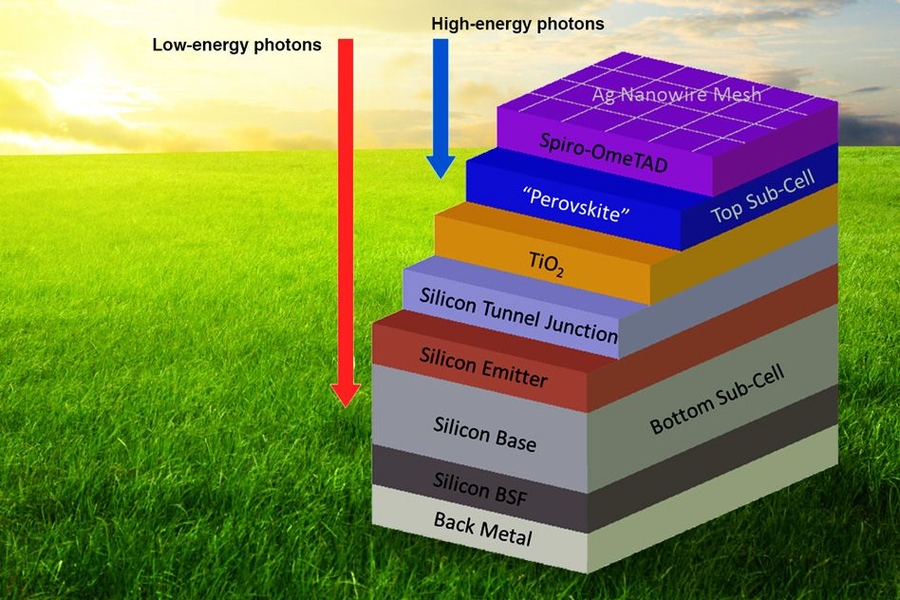
Tandem solar cells combine two or more layers of solar materials with different band gaps to absorb more of the solar spectrum. The most common tandem architecture pairs a perovskite top layer with a silicon bottom layer.
This combination allows the perovskite layer to absorb high-energy photons (blue and green light), while the silicon layer captures lower-energy photons (red and infrared). As a result, tandem solar cells can surpass the efficiency limits of single-junction technologies.
Benefits of Tandem Cells:
- Higher theoretical efficiency (~30%+ compared to ~22% for typical silicon panels)
- More complete use of sunlight across a broader wavelength range
- Reduced energy losses from heat and photon mismatch
- Potential to reduce panel area per watt
Why This Matters: Efficiency and Cost
Traditional silicon panels have a theoretical efficiency limit of approximately 29% (known as the Shockley–Queisser limit), and most commercial modules today operate at efficiencies of 18–22%. Tandem solar cells have already demonstrated lab efficiencies of over 33%, and perovskite-only cells are not far behind.
Greater efficiency means:
- More electricity from the same surface area
- Smaller, lighter, and less expensive balance-of-system (BOS) costs
- Lower cost per watt over the lifetime of the system
For large-scale installations where land and materials are a concern, this can translate to significant cost savings and a higher energy yield per square foot.
Challenges Facing Perovskite and Tandem Technologies
Despite promising results, commercial adoption still faces some hurdles:
- Stability and Durability
Perovskites are sensitive to moisture, oxygen, heat, and UV light. Researchers are working to improve encapsulation and stability for lifespans of 25 years or more. - Lead Toxicity
Most high-efficiency perovskite formulas contain lead. Efforts are ongoing to develop lead-free or encapsulated safer alternatives. - Manufacturing Scalability
Scaling lab results to gigawatt-scale production requires investment in new manufacturing techniques and supply chains. - Cost of Tandem Integration
Pairing two different materials (e.g., perovskite and silicon) involves complex alignment and interconnection that must be simplified for mass production.
Current State of the Market (2025)
- Oxford PV (UK-based): Reported commercial tandem modules with over 28% efficiency, with plans for larger-scale production in 2025.
- MIT and NREL Labs Have developed stable tandem cells that last over 1,000 hours in harsh conditions.
- Heliatek & Saule Technologies: Exploring flexible, printable solar sheets for windows and mobile charging.
- China: Major silicon manufacturers, such as LONGi and JA Solar, are investing in perovskite R&D as part of their next-generation product pipeline.
With increased funding from governments and private investors, many expect a limited commercial rollout of tandem modules in late 2025–2026, particularly for niche applications such as aerospace, consumer electronics, and high-end architectural installations.
Applications of Perovskite and Tandem Panels
- Urban Environments
Higher efficiency enables more energy generation within limited rooftop space. - Electric Vehicles and Portable Solar
Lightweight, flexible perovskites are ideal for curved surfaces and integrated solar charging systems. - Green Buildings
Semi-transparent perovskite glass panels can be used for windows or facades, combining aesthetics with function. - Space and Aerospace
High power-to-weight ratios make these ideal for satellites, drones, and high-altitude aircraft.
The Road Ahead: What to Expect
As perovskite and tandem solar technologies evolve, here’s what the near future holds:
- 30%+ efficient commercial modules by 2026–2027
- Flexible and transparent solar windows for urban and industrial applications
- Hybrid silicon-perovskite panels are available for commercial rooftop use
- Stable, lead-free perovskite formulas to reduce environmental concerns
Industry experts believe that tandem and perovskite panels could become mainstream within 5–7 years, especially if silicon prices rise or space constraints increase demand for ultra-efficient modules.
Conclusion
Perovskite and tandem solar cells are not just academic breakthroughs—they represent the future of high-performance solar technology. With record-breaking efficiencies, potential for lower production costs, and growing investment, these innovations are poised to redefine how we harness the sun’s power.
As the solar energy market shifts toward more intelligent, more efficient systems, forward-thinking solar providers like Unicorn Solar are closely tracking these developments to ensure clients benefit from the best technologies available today and tomorrow.