
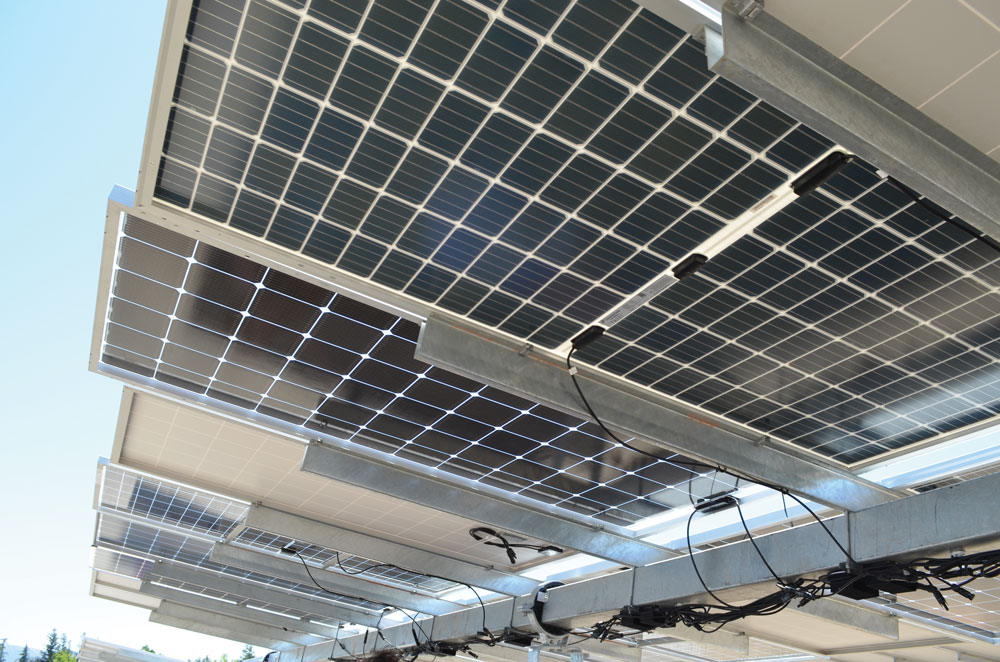
As solar technology continues to evolve, bifacial solar panels have emerged as a compelling innovation, offering higher energy yields and greater design flexibility compared to traditional mono‑facial modules. Unlike standard panels that capture sunlight on only one side, bifacial modules harness solar irradiance on both their front and rear surfaces—turning reflected light from the ground or surrounding surfaces into additional electricity. In this 800‑word guide, we’ll explore how bifacial solar panels work, their advantages, ideal installation scenarios, performance factors, economic considerations, and future developments.
How Bifacial Solar Panels Work
Traditional photovoltaic (PV) panels consist of a glass or polymer front sheet, a layer of solar cells, and an opaque backing—designed to capture direct sunlight. Bifacial solar panels, by contrast, replace the opaque backing with a transparent or semi‑transparent material (usually glass), allowing light to penetrate and be absorbed by cells on the rear side. The two active surfaces are connected internally, so electricity generated on both faces flows through the same circuit.
Light that strikes the front generates power directly, while light reflected from surfaces—such as ground cover, rooftops, or even snow—reaches the rear face. This reflected component is known as albedo, and it can contribute anywhere from 5% to 30% additional energy yield, depending on site conditions.
Key Benefits of Bifacial Solar Panels
- Higher Energy Yield
By capturing both direct and reflected sunlight, bifacial modules can produce up to 25% more energy annually than comparable mono‑facial panels under optimal conditions. - Improved Performance in Low‑Light Conditions
Because they can absorb diffuse and reflected light, bifacial panels often perform better during early morning, late afternoon, or cloudy days. - Longer Lifespan and Durability
Many bifacial panels utilize glass‑to‑glass construction, which seals cells between two tempered glass layers. This design enhances mechanical strength, reduces moisture ingress, and can extend the module lifespan beyond 30 years. - Aesthetic Flexibility
Semi‑transparent bifacial modules can serve as architectural elements—such as pergola canopies or atrium skylights—blending functionality with modern design.
Ideal Installation Scenarios
To maximize the performance of bifacial solar panels, specific site and mounting conditions are best:
- High‑Albedo Surfaces: Light‑colored gravel, white concrete, or snow‑prone regions reflect more sunlight, boosting rear‑side generation.
- Elevated Mounting: Ground‑mounted arrays with a greater distance between the panel and the surface allow more reflected light to reach the rear. Tracking systems that tilt panels throughout the day can further increase energy capture.
- Rooftop Installations: Flat roofs with white or reflective membranes can also enhance albedo, though yield gains may be more modest compared to open‑field installations.
- Cold Climates: Snow cover not only adds reflectivity but also keeps panels cooler, improving efficiency.
Performance Factors and Considerations
When evaluating bifacial systems, several variables influence actual energy gains:
- Albedo Coefficient: The reflectivity of the ground surface directly impacts rear‑side irradiation. Surfaces rated 0.2 (grass) to 0.9 (fresh snow) yield widely different results.
- Module Height and Tilt Angle: Optimal tilt angles (typically 10°–30°) and elevation above the surface (0.5 m or more) enable reflected photons to reach the back without obstruction.
- Row Spacing and Layout: Avoiding shading between rows is critical. Wider spacing increases land use but maximizes energy gains.
- Temperature Coefficients: Bifacial panels often exhibit slightly higher temperature resilience; however, system designers should still account for heat-related efficiency losses when sizing arrays.
Economic Analysis
While bifacial modules tend to carry a 5%–15% higher upfront cost than mono‑facial equivalents, the increased energy yield can accelerate return on investment:
- Levelized Cost of Electricity (LCOE): Higher annual output reduces LCOE, often making bifacial arrays competitive for utility‑scale and commercial projects.
- Incentive Programs: In many U.S. states, performance-based incentives or renewable energy credits are tied to the kilowatt-hours generated. Bifacial systems can qualify for more credits, improving project economics.
- Maintenance Considerations: The glass-to-glass design simplifies cleaning and often requires less frequent maintenance, resulting in lower operational costs over the system’s life.
Case Studies and Real‑World Deployments
Several landmark projects showcase the potential of bifacial solar panels:
- Utility‑Scale Farms: In the Nevada desert and Spanish plains, bifacial trackers have delivered 15%–20% more annual yield compared to mono‑facial baselines.
- Commercial Rooftops: Distribution centers in the Midwest installed bifacial arrays on reflective metal roofs, achieving 8% more output without requiring additional land.
- Agrivoltaics: Pilot farms in France integrated bifacial panels above crops; the extra light on the panel back and filtered sunlight below enhanced both power generation and crop yields.
Future Trends and Innovations
As the solar market matures, bifacial technology continues to advance:
- Higher‑Efficiency Cell Technologies: Perovskite and tandem cell integration promise to boost bifacial panel efficiency beyond 25%.
- Enhanced Tracking Algorithms: Machine‑learning–driven trackers optimize tilt and azimuth in real-time, maximizing rear‑side capture.
- Hybrid Solar Canopies: Combining bifacial modules with EV charging stations or shading structures creates multifunctional assets.
- Recycling and Circularity: Glass‑to‑glass panels are easier to reclaim at end‑of‑life, supporting sustainable manufacturing and waste reduction.
Conclusion
Bifacial solar panels represent a significant evolution in photovoltaic design—turning reflected light into value and delivering higher energy yields, improved durability, and versatile aesthetics. Whether for large‑scale solar farms, commercial rooftops, or innovative agrivoltaic installations, bifacial technology offers a path to lower LCOE and more resilient clean‑energy systems. As module efficiencies climb and deployment costs fall, bifacial panels are poised to play an increasingly central role in the global energy transition.
Ready to explore how bifacial solar panels can maximize your project’s performance? Contact Unicorn Solar.