
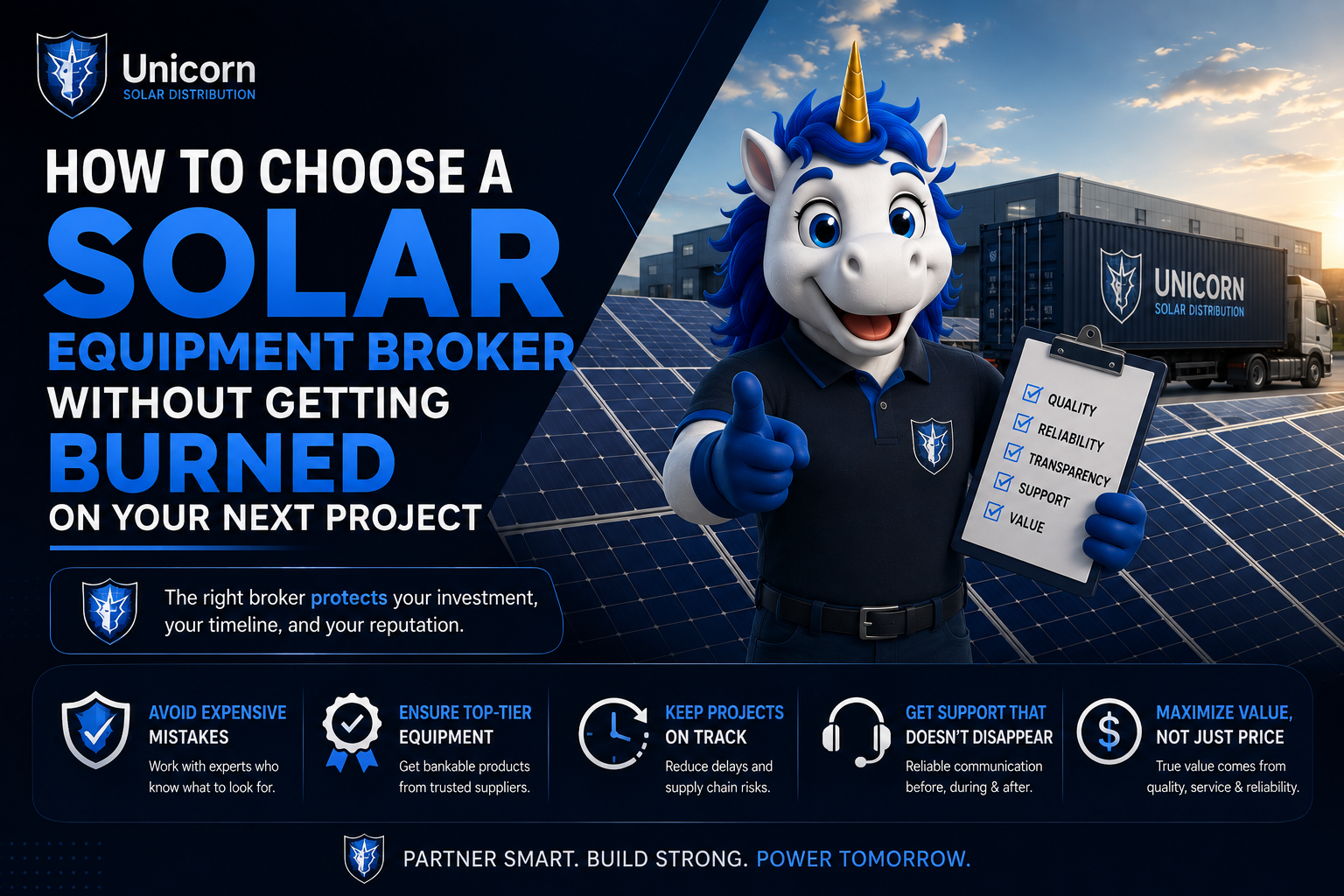
Every solar developer has a procurement horror story. A shipment of panels was stuck at customs for six weeks. A “great deal” on inverters that turned out to be from a factory nobody had actually inspected. A supplier who stopped answering emails the week before a critical delivery date.
Here’s the part that surprises people: most of these problems happened even though someone was technically acting as a broker. The title “solar equipment broker” gets used loosely. Some brokers genuinely reduce your risk. Others just add a markup between you and a factory you could’ve found yourself on Alibaba.
This article isn’t about whether you need a broker; you probably already know you do for anything beyond a small residential job. It’s about how to tell a good one from a bad one before your project’s timeline is on the line, not after.
What a Solar Equipment Broker Actually Does (Beyond Placing Orders)
A solar equipment broker’s real job isn’t finding you a price. Prices are easy to find. Their job is absorbing the risk between “the factory says this will work” and “this actually shows up, works, and doesn’t get your project flagged in an audit.” At Unicorn Solar, we take this a step further by helping businesses reduce procurement risk through trusted sourcing, supplier verification, and end-to-end project support.
That means:
Vetting the Manufacturer, Not Just the Spec Sheet
Anyone can send you a datasheet. A broker who’s done their job has actually visited or audited the factory, checked production capacity against your timeline, and knows whether that manufacturer has a history of shipping delays or quality complaints.
Managing Compliance and Trade Risk
Tariffs on solar components change often, and classification rules are genuinely confusing. A broker with experience in this space should be flagging country-of-origin and tariff exposure before you commit, not after customs holds your shipment.
Having a Backup When Plan A Falls Through
This is the part that separates brokers from order-takers. If a factory fails an audit, has a fire, or simply can’t hit your delivery window, does your broker have another qualified manufacturer ready to go? Or are you starting from zero?
The Mistake Most Developers Make: Sourcing on Price Alone
It’s tempting to treat solar equipment like a commodity and just take the lowest quote. On paper, two modules with the same wattage and warranty look identical. In practice, they’re not.
Cell quality, factory QC processes, and even how panels are packaged for shipping all affect failure rates down the line. A panel that’s 2% cheaper isn’t a good deal if 5% of the batch fails inspection or degrades faster than spec.
Red Flags to Watch for When Choosing a Broker
- They can’t tell you which factory your equipment is actually coming from
- No mention of quality inspections or factory audits before shipment
- Only one supplier relationship per product category (no backup plan)
- Vague or evasive answers about logistics, timelines, and insurance during transit
- Financing, warranty, and post-sale support aren’t part of the conversation at all
- Pricing that’s noticeably below every other quote, with no explanation why
Real-World Examples
The tariff surprise. A commercial developer sourced modules directly from a factory based on price, without anyone checking the country-of-origin classification against current trade rules. The shipment got reclassified at customs, triggering a tariff the project hadn’t budgeted for and a six-week hold while paperwork was sorted out. The project missed its interconnection window.
The audit that saved the timeline. On a utility-scale project, the primary module manufacturer failed a routine quality audit mid-production, over a cell defect rate that was creeping upward. Because the broker had a second qualified manufacturer already vetted for that exact spec, the order shifted suppliers within days instead of restarting the sourcing process from scratch.
The cheap panels that weren’t. A developer chose the lowest of four quotes for a mid-size commercial array. Within the first year, a noticeably higher-than-normal number of panels showed cell cracking and had to be replaced under warranty, a process that took months and required re-mobilizing an install crew for a job that should have been finished.
FAQ
Is a solar equipment broker the same as a distributor?
Not quite. A distributor typically holds inventory from a limited set of manufacturers. A broker works across multiple manufacturers and focuses on matching your project’s specs, budget, and timeline to the right source, often with more flexibility on where equipment comes from.
Is It Cheaper to Buy Direct or Through a Broker?
Sometimes the sticker price is slightly higher, but “buying direct” often means you’re absorbing the audit, logistics, and compliance risk yourself. For anything beyond a small job, that risk usually costs more than the broker’s margin if something goes wrong.
Can a broker help with financing, not just equipment?
Good ones often can, either directly or through partners, especially for utility-scale and commercial projects where financing and equipment sourcing timelines need to line up.
What size project actually needs a broker?
Once you’re beyond a handful of residential installs and into commercial or utility-scale work, the stakes of a bad sourcing decision go up fast. That’s usually the point where a broker’s factory relationships and risk management start paying for themselves.
How do I know if a broker actually does factory audits?
Ask directly, and ask for specifics, which factories, when, and what was checked. A broker who’s actually done this will have a clear answer. Vague reassurance is a sign they haven’t.
Wrapping Up
Choosing a solar equipment broker isn’t about finding someone to place an order for you; you can do that yourself. It’s about finding someone who’s already done the hard part: vetting the manufacturer, understanding the compliance landscape, and having a plan for when things don’t go perfectly. In my experience, most procurement failures on solar projects don’t come from skipping a broker entirely. They come from working with someoneone who never actually reduced any risk in the first place, just added a step in the middle. If you’re sourcing equipment for a commercial or utility-scale project in California and want a second opinion on your supply chain before you commit, get in touch with Unicorn Solar for a free consultation. Worst case, you walk away with a sharper set of questions to ask whoever you end up working with and you Contact Unicorn Solar for a free consultation
