
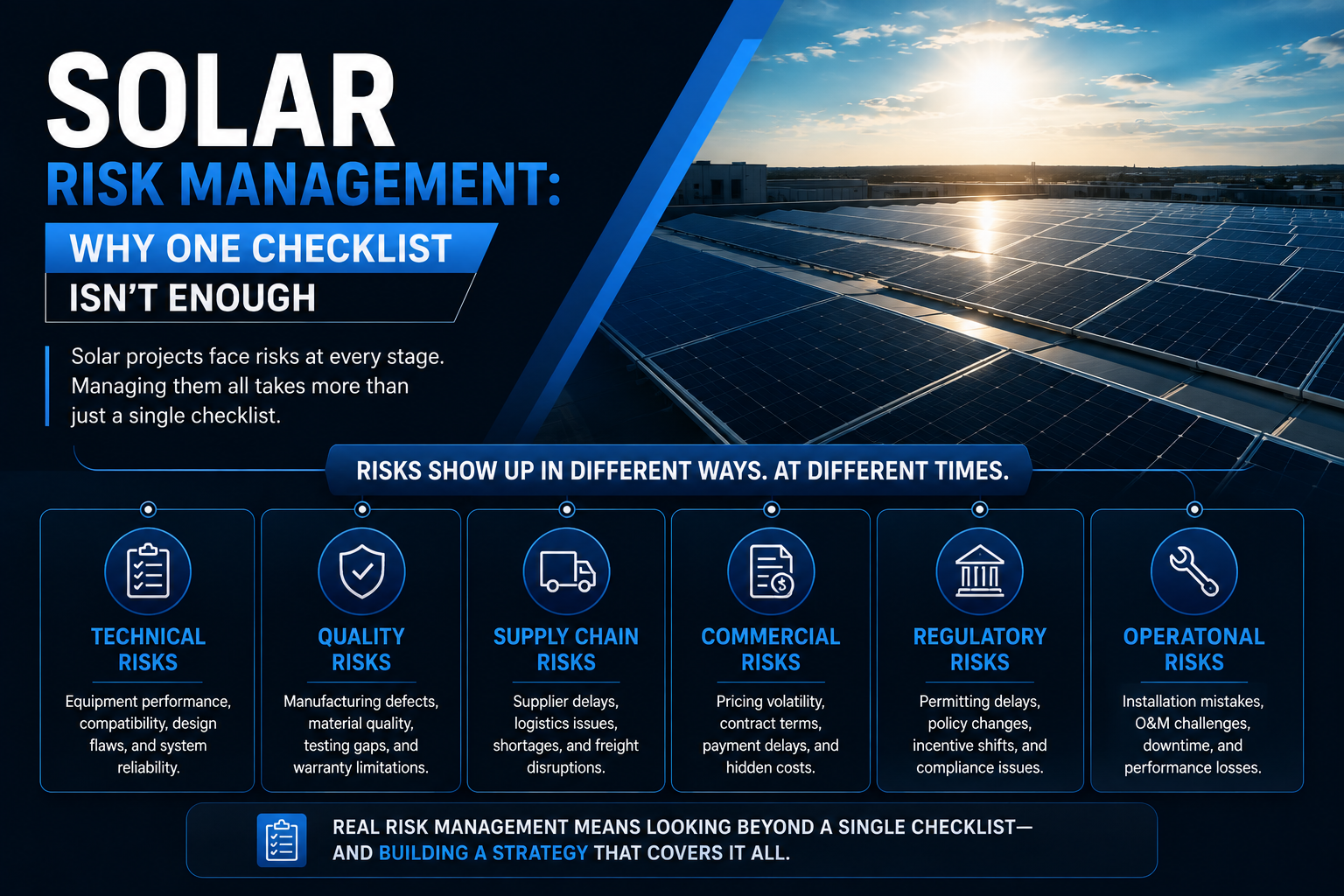
A developer can do everything right on equipment vetting, run every quality check, confirm every warranty term, and still get blindsided by a six-month interconnection delay that has nothing to do with any piece of hardware. That’s the thing about solar risk management that a lot of project teams miss: it’s not one category of risk with one set of best practices. It’s several distinct categories that show up at different points in a project, and each one needs its own approach.
Treating “risk management” as a single generic checklist is how gaps happen. A team focused entirely on equipment quality can still get caught off guard by a permitting delay, an insurance gap, or a performance contract that doesn’t actually cover the failure mode that occurs.
Here’s a practical breakdown of the risk categories that actually matter across a solar project’s lifecycle, and what tends to get overlooked in each one.
Development Risk: Before Anything Gets Built
Development risk covers everything that can go wrong before construction starts, including site control issues, permitting delays, and interconnection queue uncertainty.
Interconnection risk deserves particular attention here, since queue times and requirements have grown more unpredictable in many regions. A project can have financing, land, and equipment all lined up and still stall for months waiting on utility approval. Getting a realistic read on local interconnection timelines early, rather than assuming a standard timeline will hold, is one of the more overlooked steps in development risk management.
Construction Risk: Equipment, Logistics, and Execution
This is the category most people think of first when they hear solar risk management, and it includes equipment quality, supply chain reliability, and construction execution. It’s also the category covered in depth elsewhere on this site, since it’s a large piece of overall project risk, but it’s worth saying clearly: it’s one piece, not the whole picture.
Construction risk includes things like equipment defects, shipping delays, and contractor performance, but also less obvious factors like whether your EPC contract clearly assigns responsibility if a delay is caused by a subcontractor rather than the main contractor.
Performance Risk: Whether the Project Delivers What Was Promised
Performance risk covers whether the system actually generates the energy output that was modeled during development. This includes equipment degradation rates, weather variability, and whether operations and maintenance contracts are structured to catch and address underperformance quickly.
A common gap here is an O&M contract that looks comprehensive on paper but doesn’t actually cover the specific failure mode that ends up occurring. A performance guarantee that covers equipment failure but not gradual degradation, for example, can leave a real production shortfall uncompensated.
Financial and Insurance Risk: The Coverage Gap Nobody Checks Until It’s Too Late
Insurance policies for solar projects need to match actual site conditions and risk exposure, and this is an area where generic coverage can leave real gaps. A policy written without accounting for a site’s specific wildfire, flood, or extreme weather exposure may not actually cover the event most likely to affect that particular location.
Financial risk also includes things like currency exposure on international equipment purchases, financing terms that don’t align with construction or delivery timelines, and tax credit or incentive requirements that need to be met precisely to avoid losing expected value.
Weather and Environmental Risk: Increasingly Site-Specific
Extreme weather events, from hail to high wind to wildfire-adjacent conditions, are a growing consideration in project risk assessment. This overlaps with insurance risk, but it also affects equipment selection, since not all equipment is rated the same way for hail impact resistance or wind loading, and site-specific conditions should inform those choices rather than defaulting to standard specifications.
Why Treating These as One Category Creates Gaps
The real risk in solar risk management often isn’t any single category being ignored. It’s the assumption that strong performance in one category, like equipment vetting, means the project is broadly protected. A project with excellent equipment quality control can still face a major setback from an interconnection delay, an insurance gap, or a performance contract that doesn’t cover what actually goes wrong.
A Practical Framework for Thinking About Solar Project Risk
- Development risk: Site control, permitting, and interconnection timeline realism
- Construction risk: Equipment quality, supply chain reliability, and contractor accountability
- To understand performance risk: look at degradation speed, O&M contract limits, and what the production guarantee promises.
- Financial risk: Financing alignment, currency exposure, and incentive compliance
- Insurance risk: Coverage matched to actual site-specific conditions, not generic policy terms
- Weather and environmental risk: Equipment ratings and site assessment specific to local exposure
Real-World Examples
The interconnection blindside. A developer with a thoroughly vetted equipment supply chain and strong construction execution still faced a lengthy delay when the utility’s interconnection queue took significantly longer than the timeline the project had been planned around, an issue entirely separate from anything related to equipment or construction quality.
The insurance gap. A project’s insurance policy was written using standard terms without a detailed review of the site’s specific wildfire exposure. When a wildfire-adjacent event caused damage, the policy’s coverage terms didn’t align well with the actual circumstances, leaving a portion of the loss uncompensated.
The performance contract mismatch. The maintenance contract handled immediate failures but left room for uncertainty when output slowly fell below expected levels. When a batch of panels underperformed their expected degradation curve, the contract terms didn’t provide the compensation the asset owner expected.
FAQ
Is equipment risk the biggest category of solar project risk?
It’s a key factor, but there are other elements to consider as well. Development, performance, financial, and insurance risk can each have just as much impact on a project’s outcome, depending on the specific circumstances.
How early should interconnection risk be assessed?
As early as possible, ideally during initial site evaluation, since interconnection timelines can significantly affect overall project scheduling and should inform financing and construction planning from the start.
Does a strong equipment vetting process reduce other categories of risk too?
It helps with construction and performance risk specifically, but it doesn’t address development, financial, or insurance risk, which require their own separate attention.
How often should insurance coverage be reviewed for solar projects?
It’s worth reviewing at the start of a project and periodically afterward, especially if site conditions, regional weather patterns, or the project’s risk profile change over time.
What’s the most commonly overlooked risk category in solar projects?
Performance risk tends to get less attention than construction or equipment risk, particularly whether O&M and warranty contracts actually cover the specific ways a system can underperform, not just outright failure.
Wrapping Up
Solar risk management works best as a lifecycle view, not a single checklist. Development, construction, performance, financial, and insurance risk each show up at different points and need different mitigation strategies, and strength in one area doesn’t automatically cover the others. My honest take, from where our own expertise sits: equipment and procurement risk is one of the most controllable pieces of this picture, since it comes down to specific, verifiable decisions about who you’re sourcing from and how thoroughly that’s been vetted. It’s not the whole risk picture, but it’s a meaningful piece you can address directly. If equipment and procurement risk is the piece you want a closer look at for an upcoming project, reach out to Unicorn Solar for a free consultation on where your current sourcing approach might need attention.
