
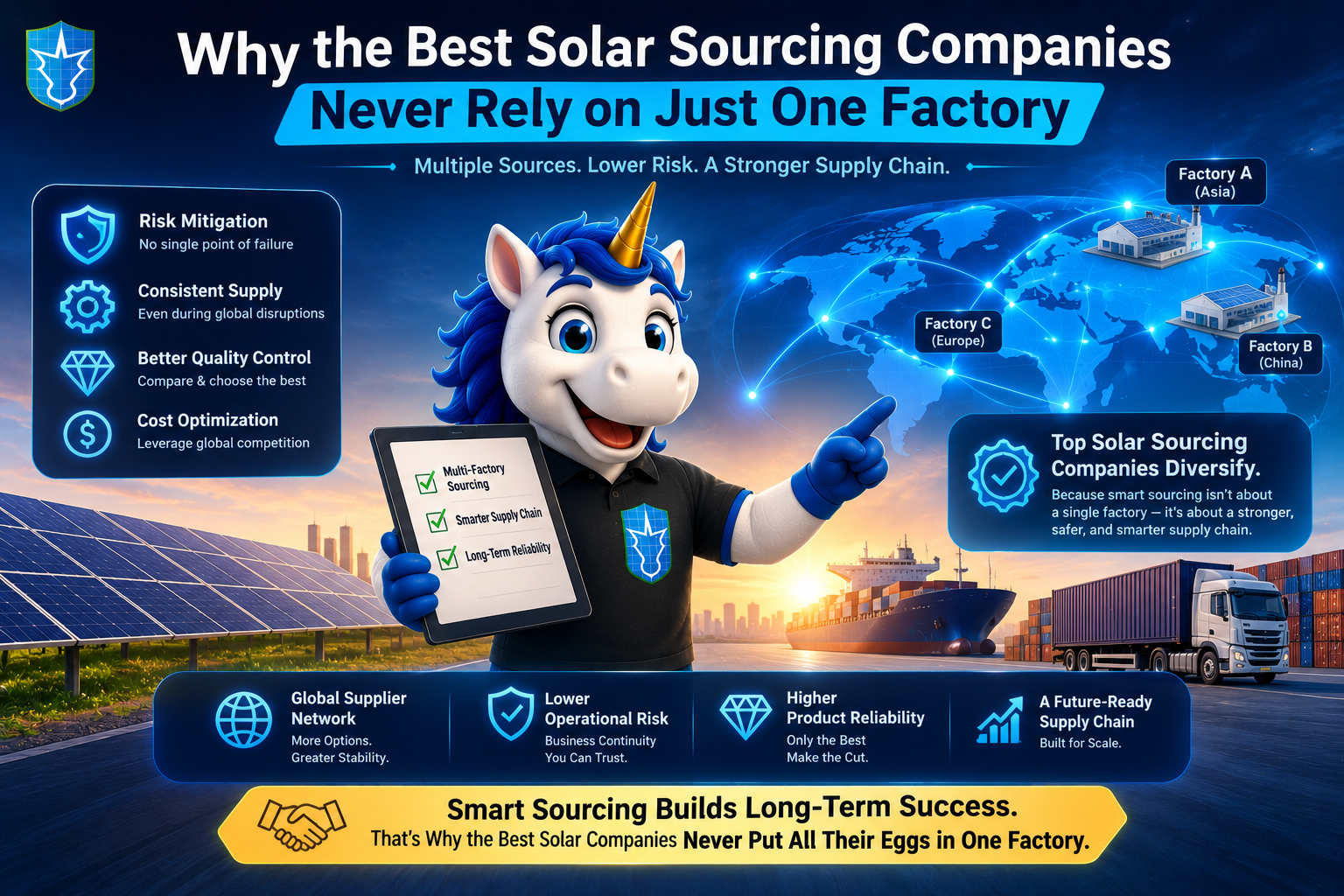
A developer we talked to recently had their entire module order tied to one factory in one country. Good factory, solid track record, competitive price. Then a regional shipping bottleneck hit, and that single dependency turned into a three-month delay with no fallback in place.
Nothing was wrong with the factory. The problem was the sourcing strategy: one supplier, one country, one point of failure. And it’s a more common setup than you’d think, because single-sourcing looks simpler and often looks cheaper, right up until something disrupts it.
This is the part of working with a solar sourcing company that doesn’t get talked about enough. It’s not just about finding equipment. It’s about whether your supplier network can absorb a disruption without your project timeline absorbing it instead. Here’s what that actually looks like in practice.
The Hidden Cost of Single-Source Sourcing
When everything’s going well, sourcing from one factory feels efficient. You know the product, you trust the relationship, and negotiating gets easier over time. The risk shows up when something outside anyone’s control happens: a labor dispute, a regional shipping delay, a sudden tariff change, or the factory simply hitting capacity limits during your delivery window.
At that point, there’s no plan B. You’re either waiting it out or scrambling to qualify a new supplier under time pressure, which is a much worse position than qualifying one in advance.
What Diversified Sourcing Actually Looks Like
Multiple Qualified Manufacturers Per Product Category
This doesn’t mean splitting every order across five factories. It means having more than one manufacturer already vetted and ready for your specs, so a disruption with one doesn’t stop your project.
Geographic Spread, Not Just Supplier Spread
Two factories in the same region can both get hit by the same disruption, like a regional shipping delay or a country-specific tariff change. Real diversification means spreading sourcing across regions, not just across company names.
Relationships That Existed Before You Needed Them
Qualifying a new manufacturer takes time: reviewing production capacity, checking quality history, and understanding their compliance track record. A sourcing company that only starts this process after something goes wrong is already behind. The value is in having done that work ahead of time.
Why This Matters More Right Now
Trade policy around solar components has shifted more than once in recent years, and tariff classifications can change with little warning. A sourcing strategy that assumes today’s trade rules will hold for the life of a multi-year project pipeline is taking on risk it doesn’t need to.
Diversified sourcing isn’t just about avoiding factory-level problems. It’s also a hedge against policy-level ones, since equipment from more than one country gives you options if the cost or availability of one changes.
Signs a Sourcing Company Isn’t Actually Diversified
- Every quote for a given product category comes from the same single manufacturer
- No clear answer when you ask what the backup plan is if that factory can’t deliver.
- All sourcing is concentrated in one country, with no alternative regions mentioned
- New supplier relationships only get built after a problem happens, not before
- Pricing discussions never mention how sourcing choices relate to current tariff exposure
Real-World Examples
The single-country stall. A commercial developer sourced modules exclusively from one manufacturer in one country. When a regional shipping bottleneck hit that country’s ports, every order routed through them was delayed by months, with no alternative supplier qualified to pick up the slack.
The tariff hedge that worked. A project with dual-sourced modules from two different countries was able to shift volume toward the unaffected supplier when a new tariff was announced on imports from one of them, avoiding a cost spike that a single-source project would have absorbed in full.
The rerouted order. When one country’s customs process backed up for several weeks due to new inspection requirements, a developer working with a sourcing company that had a second qualified manufacturer in a different region was able to reroute the order there with only a minor delay, instead of waiting out the backlog.
FAQ
Isn’t it more expensive to work with multiple manufacturers instead of one?
Not usually, since you’re not splitting every order, you’re keeping alternatives qualified and ready. The cost of not having a backup, in the form of delays or emergency sourcing, is typically far higher than the cost of maintaining the relationship.
How many suppliers does a project actually need per equipment type?
There’s no fixed number, but having at least one qualified alternative per major equipment category is a reasonable baseline for anything beyond a small project.
Does geographic diversification actually reduce tariff risk?
It can help, since tariffs and trade rules often apply differently by country of origin. Sourcing from more than one region gives you flexibility if rules change, though it doesn’t eliminate trade risk entirely.
How do I know if my current sourcing setup is too concentrated?
A simple test: if your primary supplier couldn’t deliver for three months, do you have a qualified alternative ready, or would you be starting the vetting process from scratch?
Is this only a concern for large utility-scale projects?
It matters most for larger, multi-phase projects where a delay is costly and where sourcing decisions get repeated across many orders, but the same logic applies at smaller scales too, just with lower stakes.
Wrapping Up
A solar sourcing company’s real job isn’t finding the best factory. It’s making sure you’re never fully dependent on just one. Single-source relationships work fine until something outside anyone’s control disrupts them, and by then, it’s too late to build the backup you needed. My honest take: most developers don’t think about supply chain diversification until after a delay costs them something. It’s worth thinking about before that happens instead. If your current sourcing setup is concentrated in one factory or one country, it’s worth reviewing before your next project depends on it. Reach out to Unicorn Solar for a free consultation on building a more resilient supplier network for your upcoming projects.
