
If you’ve managed more than one solar project, you’ve probably experienced this: the module supplier hits their delivery date, but the racking system doesn’t for another three weeks. Or the inverters clear customs fine, but nobody coordinated the transformer shipment with the same freight forwarder, so now you’ve got two partial deliveries instead of one complete one.
None of these vendors did anything wrong. They just weren’t talking to each other, because nobody was managing the whole picture.
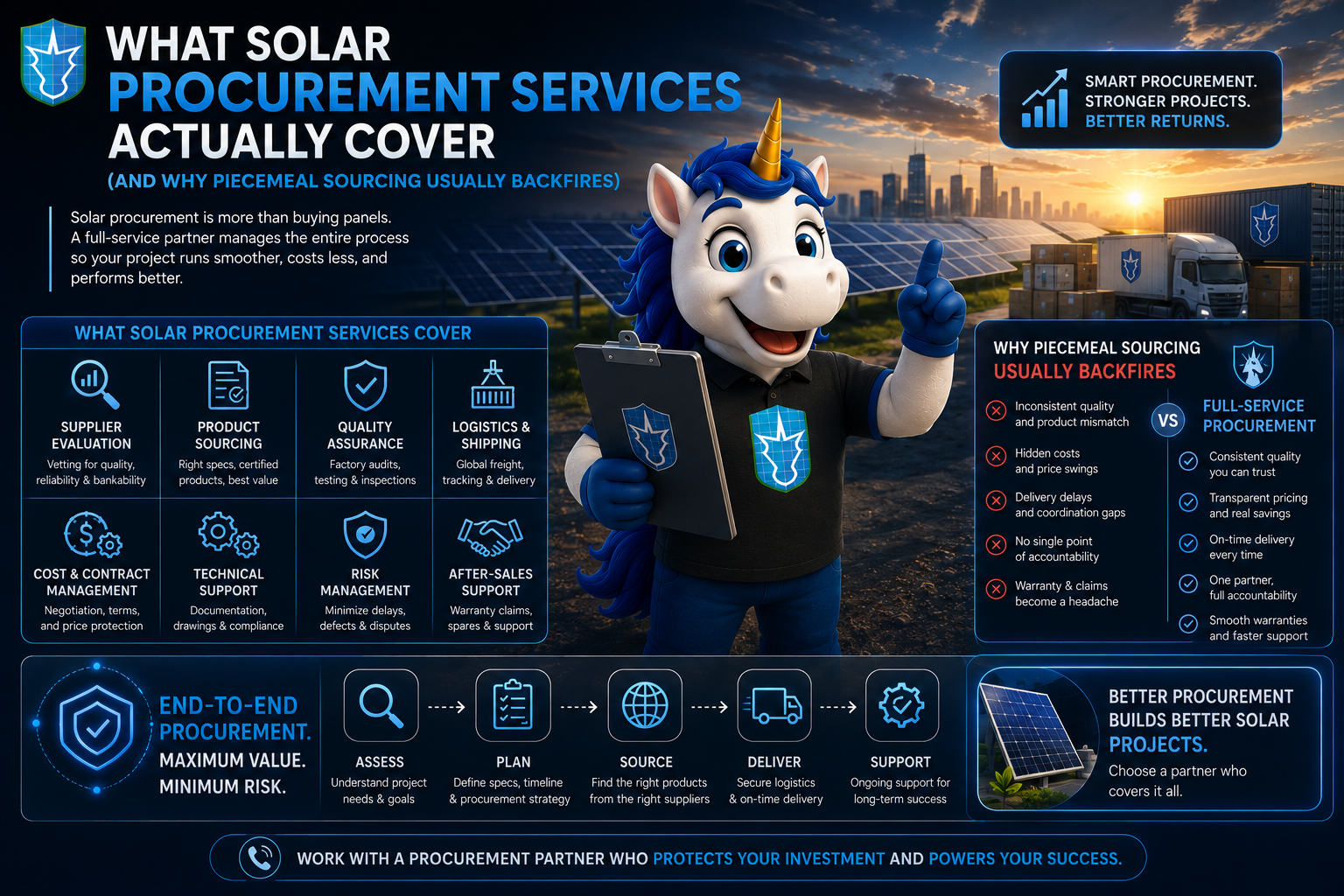
That’s the gap solar procurement services are supposed to close. Not just finding equipment at a good price, but managing sourcing, logistics, quality checks, and financing as one connected process instead of five separate relationships you’re stitching together yourself. Many people assume that “procurement” simply means purchasing. It’s a bigger job than that, and knowing what it should actually include can save you from finding out the hard way what’s missing.
Procurement Is More Than Purchasing
Buying equipment is one part of procurement. The rest is everything that has to happen around that purchase so it actually arrives, works, and fits into your project timeline:
Coordinating Delivery Windows Across Multiple Equipment Types
A utility-scale project isn’t just panels. It’s modules, inverters, racking, transformers, switchgear, and often battery storage, frequently from different manufacturers. If those orders aren’t sequenced against your actual construction schedule, you end up with expensive equipment sitting in a yard, or worse, a crew standing around waiting on the one late piece(s).
Quality Assurance Before Anything Ships
This should happen before equipment leaves the factory, not after it fails inspection on-site. Good procurement services build in checks at the manufacturing stage, so problems get caught while they’re still cheap to fix.
Logistics and Customs, Not Just Freight Booking
International shipping for solar equipment involves more than booking a container. Customs classification, tariff exposure, and insurance during transit all need to be handled correctly, and a mistake in any of them can hold up a shipment for weeks.
Financing Aligned With Delivery Timelines
Financing and procurement often get treated as separate conversations, but they’re not. If your financing terms and your equipment delivery schedule aren’t in sync, you can end up paying carrying costs on equipment you can’t use yet, or scrambling for capital right when a shipment lands.
Why Piecemeal Sourcing Usually Costs More Than It Saves
Sourcing each piece separately can look cheaper on a line-by-line basis. You shop each category for the best price and assume the savings add up. What that comparison misses is the coordination cost: the project manager’s hours spent chasing down delivery updates from five different vendors, the delays when nobody catches a scheduling conflict until it’s already a problem, and the risk of nobody being accountable when something goes wrong, because it’s not clearly any single vendor’s fault.
Signs Your Procurement Setup Has Gaps
- You’re getting delivery updates from multiple vendors with no single point of coordination
- Nobody has confirmed that equipment delivery dates actually line up with your construction schedule
- Quality checks happen after equipment arrives on-site, not before it ships
- Financing terms were arranged separately from the equipment order, with no one checking that they aligned
- You’ve had at least one delay caused by a handoff issue between two vendors, not a problem with either vendor individually
Real-World Examples
The mismatched delivery. On a commercial rooftop project, the module supplier and the racking supplier each hit their own quoted timelines, but those timelines were three weeks apart. The modules sat in storage accruing costs while the racking was still in transit, and the install crew had to be rescheduled twice.
The bundled save. A developer working with a single procurement service for both equipment sourcing and financing was able to time their capital draw to match the equipment delivery schedule almost exactly, avoiding weeks of carrying costs on hardware that would’ve otherwise sat waiting for the next construction phase to start.
The customs gap. Two separate vendors handled inverters and transformers for the same project, each using their own freight arrangements. Neither had visibility into the other’s customs documentation, and a mismatch in paperwork triggered an inspection hold that neither vendor caught until the delay was already costing the project money.
FAQ
Is solar procurement the same as just buying equipment?
Not quite. Purchasing is one piece of it. Full procurement services also cover logistics, quality checks, and often financing coordination, all managed together instead of separately.
Do I need a full procurement service for a small project?
For smaller residential or single-building commercial jobs, it’s often overkill. The coordination problems tend to show up once you’re sourcing multiple equipment types with tight, interdependent timelines, which is typically commercial and utility-scale territory.
Can procurement services help if I already have a vendor for equipment?
Often, yes. Procurement isn’t only about who you buy from. It’s also about making sure whatever you’re buying, from whoever you’re buying it from, is properly sequenced, inspected, and financed.
What’s the biggest risk of managing procurement myself across multiple vendors?
Usually, it’s not a single vendor failing. It’s the gaps between vendors, like a delivery date nobody cross-checked, or a customs issue nobody was watching for, because it fell between two parties’ responsibilities.
Does bundling procurement and financing actually save money?
It can, mainly by avoiding carrying costs on equipment that arrives before you need it, or scrambling costs when financing isn’t ready when the equipment is. The savings come from timing, not just from a better unit price.
Wrapping Up
Solar procurement services exist because a project isn’t really made up of separate purchases. It’s one connected timeline, and every piece of equipment, every shipment, and every financing decision either fits into that timeline or creates a gap in it. My take: most procurement headaches aren’t caused by bad vendors. They’re caused by nobody being responsible for the seams between vendors. That’s the actual value of treating procurement as one managed process instead of a handful of separate transactions. If your current setup has you coordinating equipment, logistics, and financing across multiple vendors on your own, it’s worth a second look. Reach out to Unicorn Solar for a free consultation on where your procurement process might have gaps, and what a more connected approach could look like for your next project.
