
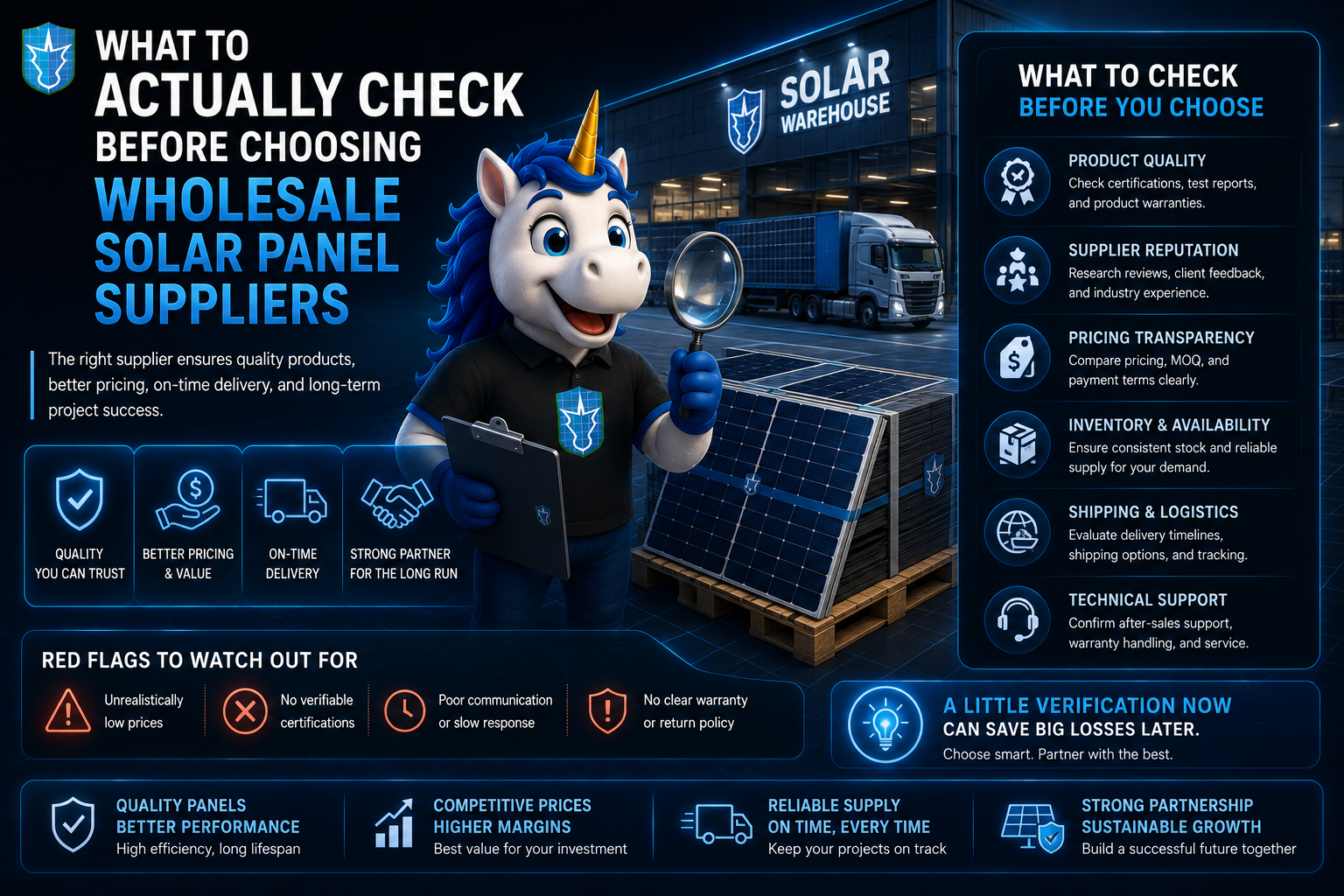
Wholesale sounds simple: buy in bulk, pay less per watt. And that part’s true. What doesn’t always come with the lower price is everything that used to be included when you were buying smaller quantities through a full-service relationship, especially when sourcing wholesale solar panels for commercial projects, things like warranty support, consistent quality across a large order, and someone who actually answers the phone if a batch shows up with problems
This catches a lot of buyers off guard, usually the ones scaling up from smaller residential or single-project volumes into real bulk purchasing for the first time. The per-watt number looks great on the quote. Then, a few months in, a portion of the order has quality issues, and it turns out “wholesale” meant the supplier’s job ended at shipping.
None of this means wholesale pricing is a bad idea. It’s usually the right move once you’re buying at real volume. It just means price per watt is the wrong single metric to shop on, and there’s a specific set of things worth confirming before you sign a large order.
Price Per Watt Isn’t the Whole Story
Two wholesale quotes with the same price per watt can represent very different deals once you factor in what’s actually included. A lower number that comes with weak warranty enforcement, no quality checks across the batch, and logistics you have to arrange yourself isn’t automatically cheaper. It’s just cheaper on the one line item that’s easiest to compare.
What a Wholesale Relationship Should Still Include
Warranty Support That Actually Functions at Volume
A 25-year warranty on paper means little if there’s no clear process for filing a claim, and no one accountable for following through when a portion of a large order underperforms. At volume, even a small failure rate translates into a meaningful number of panels, so warranty enforcement matters more, not less.
Quality Consistency Across the Full Order
A single container of panels might all come from the same production run. A multi-container wholesale order often doesn’t, especially if the supplier is pulling from different batches to fill a large quantity fast. Consistency checks across the entire order, not just a sample from the first shipment, are worth confirming upfront.
Minimum Order Quantities That Match Your Actual Need
Wholesale pricing tiers often kick in at specific volume thresholds. That’s fine if the quantity matches your project. It’s a problem if you end up buying more than you need just to hit a pricing tier, and then sitting on excess inventory that ties up capital.
Logistics That Don’t Become Your Problem After the Fact
At bulk volume, shipping isn’t one container, it’s often several, sometimes staggered over weeks. Someone needs to be tracking all of it, and that someone shouldn’t be you finding out a container is delayed only after your install crew is already on-site waiting.
Questions Worth Asking Before You Commit to a Wholesale Order
- What’s the actual warranty claims process, and who handles it if something goes wrong across a large batch?
- Are all units in this order from the same production batch, or a mix?
- What happens if the pricing tier requires more units than my project actually needs?
- Who’s coordinating logistics if the order ships across multiple containers?
- Is there a quality inspection process for large orders, or just for the sample shipment?
Real-World Examples
The warranty that wasn’t. A commercial buyer purchased a large wholesale order at an attractive per-watt price. Several months in, a batch of panels showed higher-than-expected degradation. When the buyer tried to file a warranty claim, there was no clear process and no responsive contact, since the wholesale relationship had ended at the point of shipment.
The batch catch. A buyer working through a sourcing partner on a multi-container wholesale order had each container checked against the same quality baseline. A later container showed a slight drift in cell performance compared to the earlier ones, and it was caught and addressed before installation, rather than discovered after the panels were already in the ground.
The overbuy. A smaller commercial developer needed a specific quantity of panels, but the supplier’s wholesale pricing tier required a noticeably larger order to unlock the discount. The buyer took the deal to get the better price, then ended up storing the excess inventory for months before it could be used on a future project.
FAQ
Is wholesale pricing worth it for a smaller commercial project?
Sometimes, but the minimum order quantities involved can force you into buying more than you need. It’s worth comparing the wholesale discount against the cost of storing or eventually using the excess.
How do I know if a wholesale supplier’s warranty is actually enforceable?
Ask for the specific claims process and timeline before you buy, not after. A supplier who can walk you through exactly how a claim gets filed and resolved is a better sign than one who just points to the warranty length on the datasheet.
Does buying wholesale mean sacrificing quality control?
Not necessarily, but it’s not automatic either. Some wholesale arrangements include batch-level quality checks across the full order. Others don’t, and it’s worth confirming which one you’re getting before you commit to volume.
Can a broker or sourcing partner get better wholesale pricing than buying direct?
Often yes, especially at scale, since they’re typically working across multiple manufacturers and can leverage combined volume. They can also add the quality and logistics oversight that a pure wholesale transaction might not include on its own.
What’s the biggest mistake buyers make with wholesale purchasing?
Comparing quotes purely on price per watt without checking what’s included beyond the panels themselves, then discovering the gaps only after a problem shows up.
Wrapping Up
Wholesale pricing makes sense once you’re buying at real volume. The mistake is assuming a lower per-watt number automatically means a better deal, without checking whether warranty support, quality consistency, and logistics are still part of what you’re paying for. My take: the buyers who get burned on wholesale orders usually aren’t the ones who negotiated a bad price. They’re the ones who negotiated a good price and didn’t check what else came with it. If you’re planning a bulk purchase and want to make sure the pricing you’re getting still includes real warranty support and quality oversight, Unicorn Solar can help you source reliable wholesale solar equipment with confidence before you commit to an order.
