
Most buyers of battery storage equipment focus on two numbers: capacity in kilowatt-hours and price per kilowatt-hour. Those numbers matter, but they do not tell you how long the battery will last at that capacity, how it performs in high temperatures, or whether the safety certifications match your jurisdiction’s permitting requirements.
Battery energy storage systems have matured significantly, and the options today are genuinely different in ways that affect project outcomes. A lithium iron phosphate system in a utility-scale solar-plus-storage project has very different characteristics than a nickel manganese cobalt system in a commercial demand-charge application. Knowing which battery storage system components drive long-term performance is what separates a well-specified purchase from one that underdelivers for the next decade.
What Battery Storage Equipment Actually Is
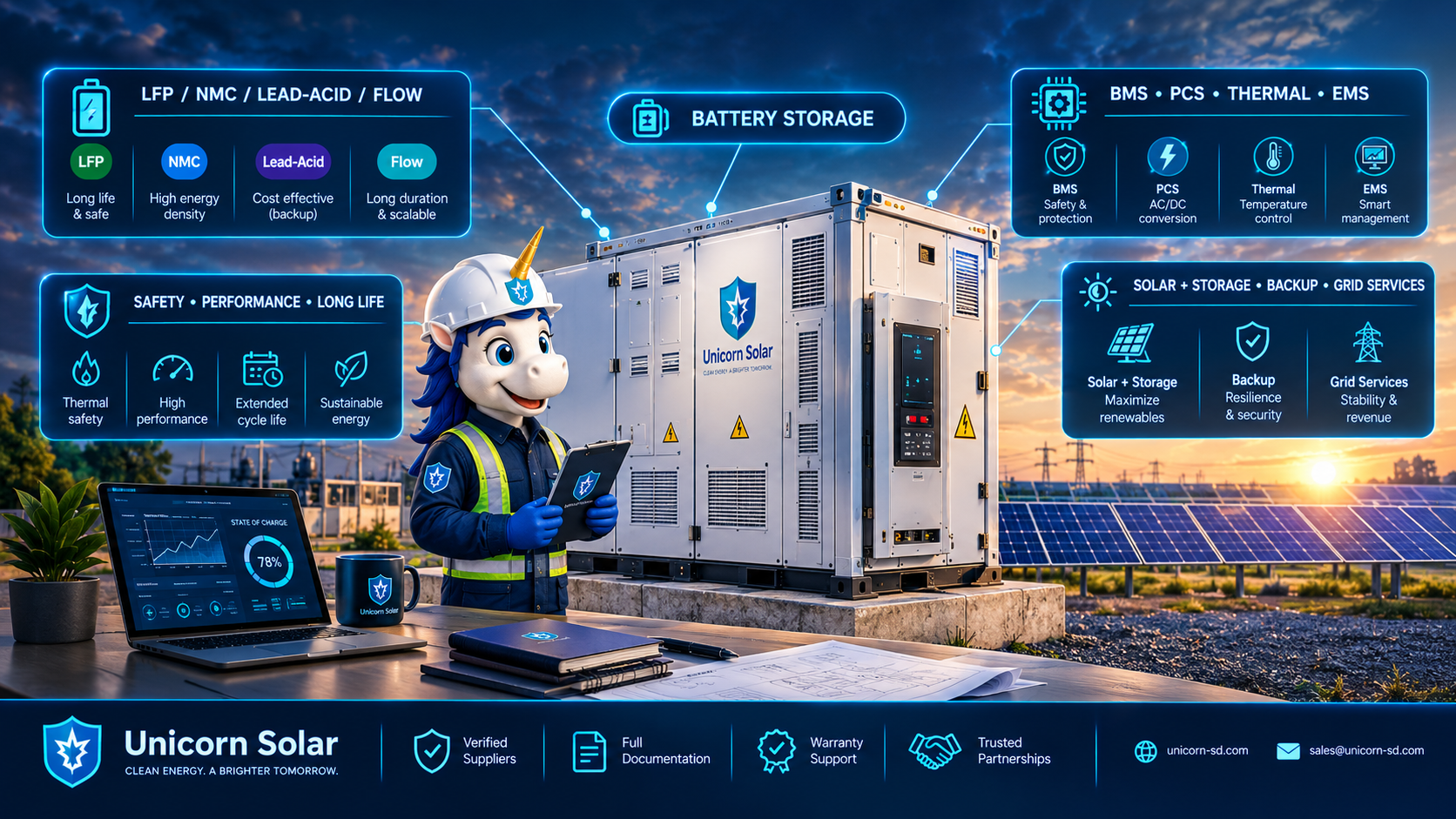
Battery storage equipment refers to the full system used to store electrical energy and release it on demand. It is not just the battery cells. A complete energy storage equipment package includes the cells or modules, the electronics that manage and protect them, the power conversion hardware that interfaces with the grid or load, and the software that controls dispatch.
Each layer affects performance, safety, and longevity. A high-quality cell paired with a poorly designed battery management system will underperform and degrade faster than a moderate cell with sophisticated controls. What is inside the system matters as much as the nameplate capacity on the outside.
Types of Battery Storage Systems
Lithium iron phosphate (LFP) has become the dominant chemistry for commercial and utility-scale battery storage solutions. Its key advantages are thermal stability, long cycle life, and safety. LFP cells are significantly less prone to thermal runaway than other lithium chemistries, which affects safety certification and insurance costs. Cycle life commonly exceeds 4,000 to 6,000 full cycles, translating to 10 to 15 years of daily cycling.
Nickel manganese cobalt (NMC) offers higher energy density in a smaller footprint and is common where space is constrained. The trade-off is higher thermal sensitivity, a shorter cycle life at equivalent depth of discharge, and higher material cost due to cobalt content.
Lead-acid batteries remain in use for backup power and smaller off-grid applications where upfront cost is the primary constraint. Significantly shorter cycle life and lower depth of discharge make them less competitive for daily cycling despite the lower initial price.
Flow batteries store energy in liquid electrolyte tanks rather than solid cells, offering the ability to scale capacity and power independently with minimal degradation over thousands of cycles. Higher system complexity limits adoption at commercial scale, but they are increasingly relevant for long-duration storage above four hours.
Key Battery Storage System Components
Understanding the main battery storage system components helps in evaluating what is actually being purchased and what affects long-term performance.
Battery modules and racks are the physical cells assembled into manageable units. Module design affects how cells are cooled, how they are replaced as individual cells degrade, and how the assembly handles thermal expansion over thousands of cycles.
The battery management system (BMS) monitors voltage, current, and temperature, balances charge across cells, enforces protection limits, and communicates state of charge to the broader control system. BMS quality directly affects safety and how aggressively the battery can be operated without accelerating degradation.
The power conversion system (PCS) converts DC power from the battery to AC for the grid or load, and back to DC during charging. PCS efficiency affects overall round-trip efficiency. A system advertised at 90% round-trip may deliver 86% or less with a weak PCS specification.
The thermal management system keeps cells within their optimal temperature range. In hot climates, inadequate cooling accelerates capacity degradation. In cold climates, inadequate heating reduces available capacity and can cause permanent damage during charging.
The energy management system (EMS) determines when the battery charges and discharges based on energy prices, grid signals, or on-site load patterns. EMS sophistication largely determines how much economic value the battery captures in operation.
Real-World Uses of Battery Energy Storage Systems
Battery storage solutions serve different functions depending on the application, and the primary use case should drive chemistry, capacity, and configuration selection.
Solar-plus-storage is the most common pairing for commercial and utility-scale projects. The battery captures excess solar generation during peak production and discharges when output drops or prices rise. Daily cycling makes cycle life and degradation rate the primary selection criteria.
Demand charge reduction uses stored energy to shorten or eliminate peak demand spikes, which can represent 30% to 50% of a commercial electricity bill. Precise control timing and a capable EMS are essential here.
Backup power and resilience prioritizes availability over cycling frequency. The battery may sit at full charge for weeks and discharge only during outages, which tolerates lower cycle-life specs but requires reliable state-of-health monitoring.
Grid services, including frequency regulation and capacity market participation, require fast response times and high cycling frequency, favoring advanced LFP or NMC chemistries with capable PCS and EMS platforms.
Common Mistakes When Sourcing Battery Storage Equipment
Comparing systems on capacity and price per kilowatt-hour alone ignores cycle life, degradation rate, and round-trip efficiency, all of which determine actual delivered cost over the system’s life.
Overlooking BMS and EMS specifications is a consistent gap in storage procurement. The software and electronics controlling the battery often determine more of real-world performance than cell chemistry does.
Selecting chemistry based on energy density without reference to the use case creates mismatches. An NMC system chosen for its compact footprint may degrade faster than expected in a high-cycling solar-plus-storage role where LFP is the better fit.
Skipping safety certification verification for the specific configuration, not just the product family, creates permitting risk that surfaces at the worst time. UL 9540 and UL 9540A must match the exact configuration being installed.
FAQs About Battery Storage Equipment
What is the difference between LFP and NMC battery energy storage systems?
LFP offers better thermal safety, longer cycle life, and lower degradation in high-cycling applications. NMC offers higher energy density in a smaller footprint but degrades faster at equivalent cycling depth and carries higher thermal risk.
What are the main battery storage system components?
Battery modules, a battery management system, a power conversion system, a thermal management system, and an energy management system are the core components. Each affects safety, performance, and longevity.
How long does battery storage equipment typically last?
LFP systems commonly support 4,000 to 6,000 full cycles, translating to 10 to 15 years of daily cycling. Lead-acid systems typically last 500 to 1,500 cycles. Actual longevity depends heavily on operating temperature, depth of discharge, and BMS quality.
Where can I source verified battery storage equipment for a commercial project?
Unicorn Solar sources energy storage equipment and balance-of-system components for commercial and utility-scale projects, providing full supplier documentation, specification verification, and warranty confirmation before equipment ships.
The Bottom Line
Battery storage equipment decisions involve more variables than capacity and price. Chemistry, BMS quality, thermal management, and EMS sophistication each affect real-world performance over the system’s life. Matching specifications to the actual use case and sourcing verified battery storage solutions from a supplier who can document every component is how storage investments deliver the returns they were designed to produce.
Source Battery Storage Equipment You Can Verify
Unicorn Solar provides verified sourcing for energy storage equipment and balance-of-system components for commercial and utility-scale projects, with full documentation before delivery. Reach out at unicorn-sd.com/contact-us for a free consultation on your next storage project.
