
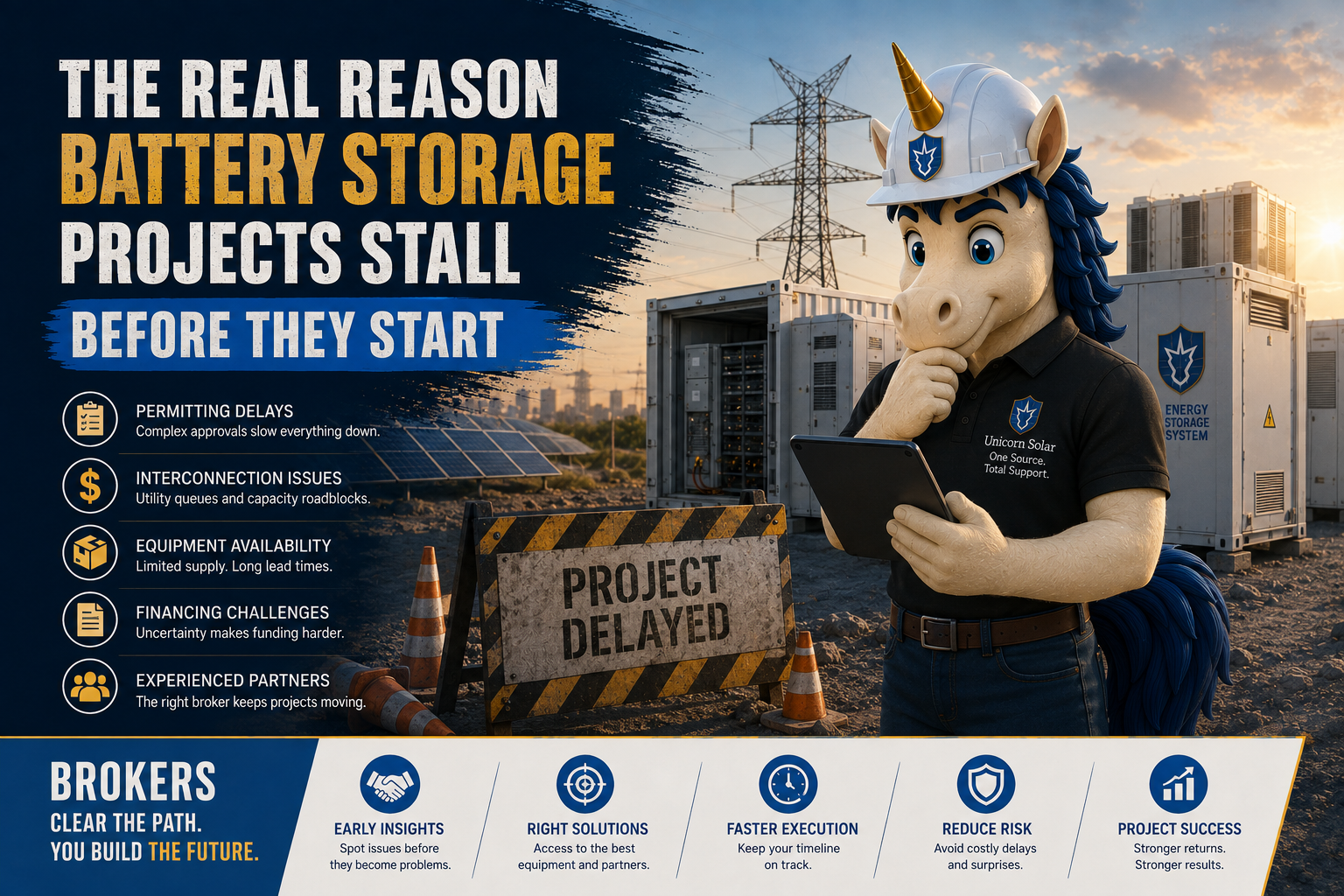
The Real Reason Battery Storage Projects Stall Before They Start
Battery storage gets pitched as the piece that makes renewable projects actually work — smoothing out solar variability, managing peak demand charges, and giving grid operators flexibility they didn’t have before. On paper, the business case is solid. In practice, a lot of battery storage projects stall out long before commissioning, and it’s rarely because the technology doesn’t work. It’s almost always procurement.
It’s Not the Technology — It’s the Timeline
Battery storage equipment has a longer and more unpredictable lead time than most developers plan for. Cell manufacturing capacity is concentrated among a small number of suppliers globally, and demand from utility-scale storage, EV manufacturing, and grid modernization projects is all competing for the same production capacity. A project that is penciled out cleanly at the planning stage can stall for months waiting on equipment that was quoted with an optimistic delivery date.
The pattern shows up consistently: permitting and interconnection approval move forward on schedule, financing closes, site work begins — and then the project sits idle waiting on a battery storage order that was placed too late or with a single manufacturer who couldn’t hold the timeline.
Where Projects Actually Get Stuck
- Procurement starts too late in the process. Battery storage is often treated as a line item to finalize after the “harder” parts of a project — interconnection, permitting, financing — are settled. But storage equipment frequently has the longest lead time of anything in the project, which means it should be sourced earliest, not last.
- A single-supplier order with no backup plan. Placing one order with one manufacturer and no contingency works fine until that manufacturer has a production delay, a component shortage, or a quality issue that requires a batch to be held back. Without a secondary sourcing path, the entire project timeline absorbs that delay.
- Spec mismatches discovered late. Battery chemistry, capacity, and integration requirements vary enough between manufacturers that a spec chosen early in design sometimes turns out to be unavailable or discontinued by the time procurement actually happens — forcing a scramble to find a comparable replacement.
- Underestimating supporting infrastructure lead times. Battery storage systems don’t operate in isolation — they typically need supporting switchgear and, depending on system size, a dedicated transformer. If those are sourced as an afterthought instead of in parallel with the batteries, they become the new bottleneck.
How Brokers Change the Timeline
This is exactly the gap battery storage equipment brokers are built to close. Instead of a single manufacturer relationship, a broker maintains visibility across multiple suppliers and secondary-market inventory — which means a stalled order with one manufacturer doesn’t have to stall the whole project.
The practical advantages line up with where projects actually get stuck:
- Earlier sourcing options — a broker can flag realistic lead times before a project is locked into a single supplier’s optimistic quote
- Backup sourcing paths — if a primary order slips, a broker with multi-supplier access can often fill the gap rather than leaving the project waiting
- Spec flexibility — comparable capacity and chemistry alternatives when the original spec becomes unavailable
- Coordinated sourcing of supporting equipment — pairing battery systems with the switchgear and transformers they depend on, so one doesn’t become the bottleneck while the other sits ready
For solar-plus-storage projects specifically, this coordination matters even more, since solar PV modules and DC combiner boxes are on their own procurement timeline too. Running all of it through one power equipment broker keeps the pieces aligned instead of arriving on separate, uncoordinated schedules.
Questions to Ask Before You Commit to a Battery Storage Order
- What’s the realistic lead time, not the best-case one? Ask specifically what happens if the quoted date slips — is there a backup plan, or does the project just wait?
- Is this a single-source order, or does the supplier have alternative capacity if something falls through?
- What certification and safety documentation comes with the system? UL 9540 and relevant fire safety certifications should be confirmed before commitment, not assumed.
- Has supporting infrastructure — switchgear, transformers — been sourced in parallel, or is it being treated as a separate, later step?
The Real Cost of a Stalled Project
It’s worth putting a number on what a stall actually costs, because it usually dwarfs any savings from sticking with a cheaper, single-source order. A delayed commissioning date can mean missed interconnection windows that push a project to the back of a utility’s queue, financing costs that keep accruing while equipment sits on backorder, and in some cases the loss of time-sensitive incentive eligibility tied to a commissioning deadline. None of that shows up on the original equipment quote, but all of it shows up on the project’s actual return.
That’s the calculation that makes broker sourcing worth evaluating even when it isn’t the absolute lowest unit price. A slightly higher equipment cost that keeps a project on schedule is almost always cheaper than the compounding cost of a multi-month stall.
Frequently Asked Questions
Why do battery storage projects have longer lead times than other renewable equipment? Battery cell manufacturing capacity is concentrated among a limited number of global suppliers, and demand from utility-scale storage, EV production, and grid projects all compete for the same production capacity, which extends and destabilizes lead times compared to more distributed supply chains.
Can a broker really help if my battery storage order is already delayed? Often yes. A broker with multi-supplier visibility can check for comparable available inventory or alternative sourcing paths that a single-manufacturer relationship doesn’t offer, which can shorten an already-slipping timeline.
Should battery storage be sourced before or after solar equipment on a combined project? Ideally in parallel, sourced as early as possible. Since battery storage frequently has the longest lead time of any component, waiting to source it until after solar equipment is finalized is one of the most common causes of project delay.
What certifications should a battery storage system have? At minimum, UL 9540 certification for the energy storage system, along with UL 9540A fire safety test data where applicable. Always confirm current documentation directly rather than assuming it based on the manufacturer’s reputation.
Is refurbished or surplus battery storage equipment safe to use? It can be, provided it comes with valid certification and test documentation. A reputable broker will verify and provide this before sale — equipment without documented certification history should be treated as a risk regardless of price.
Final Thoughts
Battery storage projects rarely stall because the technology fails — they stall because procurement gets treated as a late-stage formality instead of the critical-path item it actually is. Sourcing early, keeping a backup path open, and coordinating storage with its supporting infrastructure from the start is what separates projects that hit their commissioning date from ones that sit idle for months waiting on equipment.
Sourcing battery storage for an upcoming project? Get a quote from Unicorn on realistic lead times, availability, and supporting equipment.
