
Walk through almost any commercial or utility-scale solar installation and you will find a piece of equipment most people on the project cannot fully explain. It sits between the panel strings and the inverter, handles significant DC current, and when sourced or specified incorrectly, creates problems that are expensive to trace.
That component is the DC combiner box, and it deserves more attention than it typically gets. A solar DC combiner box is not a passive junction point. It is a protection and monitoring device that directly affects system safety, fault response, and long-term performance visibility. Getting the type, rating, and components right from the start saves significant cost during commissioning and operations.
What a DC Combiner Box Actually Does
A solar combiner box collects the output from multiple photovoltaic string circuits and combines them into a single higher-current output that feeds the inverter. In a large array with dozens of strings, running separate conduit from each string to the inverter would be impractical. The combiner box aggregates current closer to the array, reducing the wiring that has to run the longer distance.
Beyond the basic electrical function, a photovoltaic combiner box provides overcurrent protection per string through fuses or circuit breakers. Strings in a PV array can back-feed each other under certain fault conditions, and without per-string protection, a fault in one string can damage adjacent ones before it is detected.
Modern units also include string-level monitoring that tracks output per string. A string dropping to 80% of expected output due to a failed bypass diode, soiling, or shading shows up in the monitoring data immediately rather than hiding inside the aggregate inverter output.
Types of DC Combiner Boxes
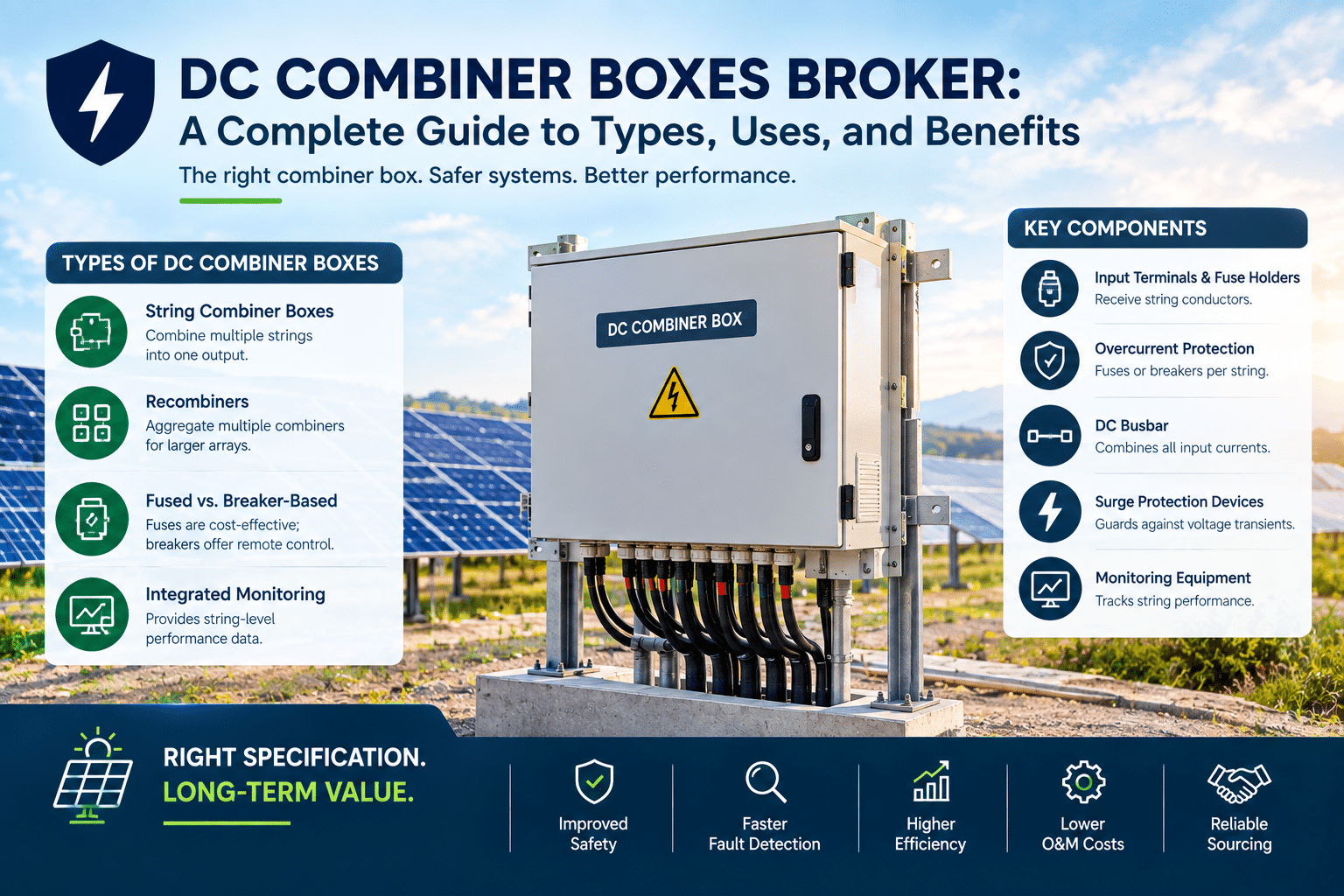
String combiner boxes are the most common type. They combine multiple strings from a single array section into one output circuit feeding the inverter or a recombiner. They typically handle between 4 and 24 input strings depending on project scale and inverter architecture.
Recombiners aggregate the outputs of multiple string combiners into a single higher-current feed, used in larger utility-scale projects where the array is too large to run from a single tier of combiners directly to the inverter.
Fused vs. breaker-based combiners represent a key design choice. Fused combiners are simpler and lower-cost, but fuse replacement requires manual intervention. Breaker-based units allow remote or automated reset and make testing individual strings much easier, a meaningful operational advantage on large systems.
Integrated monitoring combiners add current transducers on each input, feeding string-level data to the site SCADA platform. For any project where O&M costs matter, this is worth specifying upfront rather than retrofitting later.
Key DC Combiner Box Components
Understanding what is inside a solar DC combiner box helps in evaluating quality and specifying correctly for project conditions.
Input terminals and string fuse holders receive conductors from each string. Fuse holder quality matters because vibration, thermal cycling, and moisture ingress affect contact resistance over time, which creates efficiency loss and fire risk.
Overcurrent protection devices are the fuses or breakers protecting each string. The correct rating depends on string short-circuit current and the number of parallel strings that can back-feed into a fault. Undersized protection fails to trip. Oversized protection fails to catch real faults.
The DC busbar combines all of the input strings’ current. Busbar sizing must handle full combined current, and material quality affects conductivity and long-term corrosion resistance in outdoor environments.
Surge protection devices guard against voltage transients from lightning or grid switching. For utility-scale sites in high-lightning areas, surge protection is not optional.
String monitoring equipment, where included, uses current transducers on each input feeding data to the monitoring platform. This is one of the DC combiner box components with the most long-term operational value, and one most commonly skipped to reduce upfront cost.
Why Specifying the Wrong Combiner Box Creates Problems
A photovoltaic combiner box that is correctly rated and properly specified rarely draws attention after commissioning. One that is undersized or missing key components tends to surface at the worst moments.
Undersized busbars or fuse holders that develop high resistance over time create efficiency losses that appear as an unexplained gap between modeled and actual production. Boxes without string monitoring make it nearly impossible to identify which string is underperforming without manual field testing. Inadequate ingress protection ratings lead to corrosion and connection failures.
The cost difference between a well-specified solar combiner box and the minimum viable option is small relative to the project budget. The difference in operations cost over a 25-year system life is not.
Common Mistakes When Sourcing DC Combiner Boxes
Specifying based on string count alone without accounting for string short-circuit current and overcurrent protection requirements produces boxes that look correct on paper but are improperly protected in practice.
Skipping string monitoring to reduce upfront cost rarely makes sense over a multi-year operations horizon. String-level visibility catches underperformance early, and retrofitting monitoring after installation is both difficult and expensive.
Choosing enclosure ratings without reference to site conditions is a common oversight. An IP54 rating that works in a dry climate may be inadequate for a coastal or high-humidity installation.
Sourcing from unverified suppliers to hit a price target creates risk that shows up in connection quality, material durability, and whether the unit actually meets the certifications on the nameplate.
FAQs About DC Combiner Boxes
What is the purpose of a solar DC combiner box?
It combines the output from multiple PV string circuits into a single feed for the inverter, while providing overcurrent protection for each string and, in monitored versions, string-level performance visibility.
What are the main DC combiner box components?
Input terminals, string fuse holders or breakers, a DC busbar, surge protection devices, an output disconnect, and optionally current transducers for string monitoring are the core components.
What is the difference between a string combiner and a recombiner?
A string combiner aggregates outputs from individual PV strings. A recombiner aggregates the outputs of multiple string combiners in larger arrays where a single combiner tier is insufficient.
How do I know if a solar combiner box is properly rated for my project?
The fuse or breaker rating must account for string short-circuit current and parallel string count. Busbar rating must handle full combined current. Enclosure rating must match the installation environment. A verified sourcing partner like Unicorn Solar can confirm specifications against project requirements before purchase.
The Bottom Line
A DC combiner box is not a commodity item chosen purely on price. The components inside it, how it is rated, and whether it includes string monitoring all directly affect system safety, fault detection, and long-term operations cost. Getting the specification right upfront and sourcing from a verified supplier is a small investment relative to what a poorly specified unit costs over a project’s operating life.
Source Combiner Boxes With Full Specification Verification
Unicorn Solar sources solar DC combiner boxes and full balance-of-system equipment for commercial and utility-scale projects, with verified supplier documentation and specification confirmation before anything ships. Reach out at unicorn-sd.com/contact-us for a free consultation on your next project’s equipment needs.
