
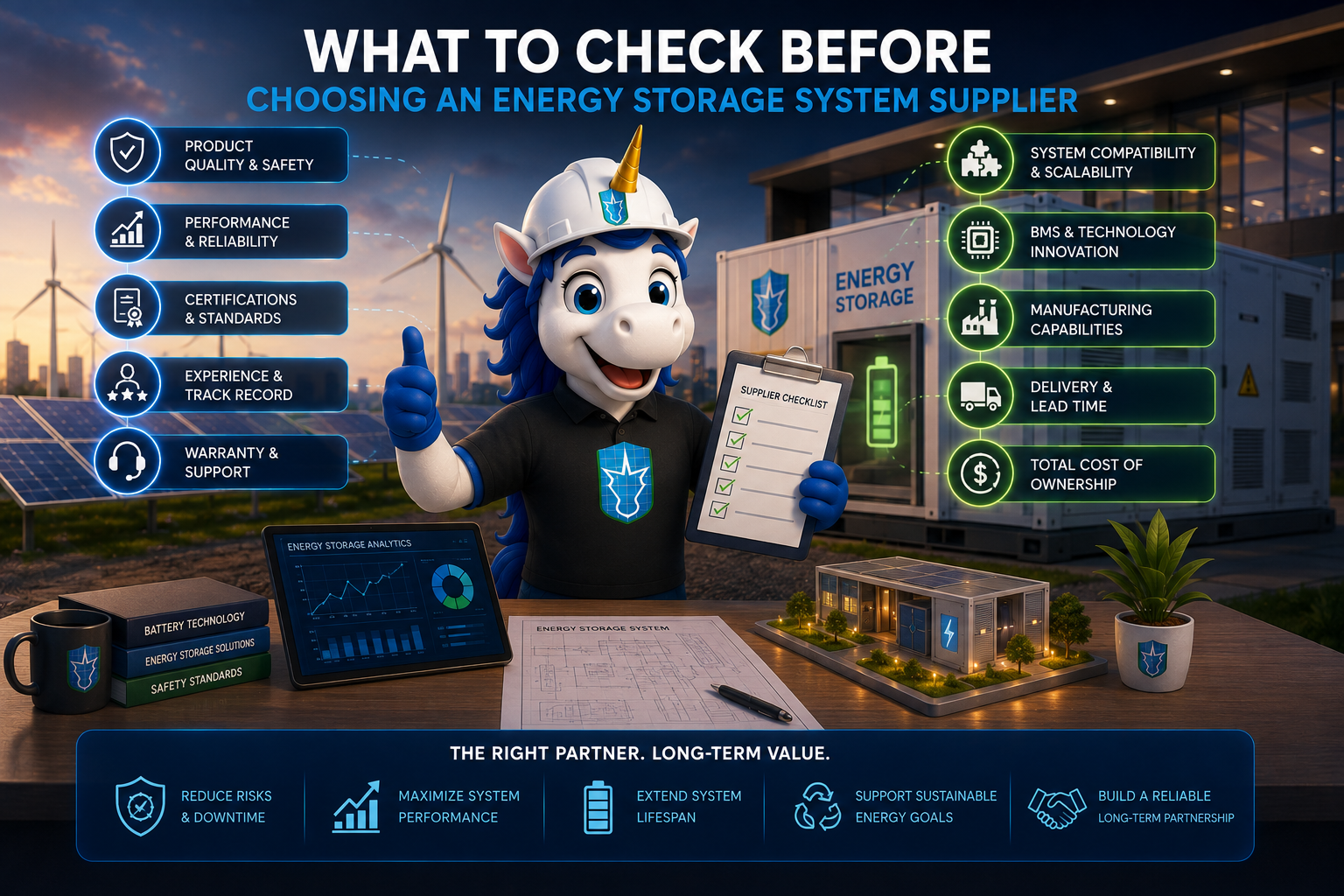
Sourcing battery storage isn’t the same problem as sourcing panels, even though people often approach it the same way. Panels are largely a hardware and warranty question. Storage systems add two things that don’t come up nearly as much with modules: strict safety certification requirements and a dependence on software that has to keep working years after installation.
Skip either of those checks, and you can end up with a system that’s hard to permit, or one that works fine on day one but loses key functionality once a manufacturer stops supporting the platform behind it.
If you’re evaluating energy storage system suppliers for a commercial or utility-scale project, here’s what actually matters beyond the spec sheet and price per kilowatt-hour.
Safety Certification Isn’t Optional, and It’s Not All the Same
Battery storage systems carry real fire risk if they’re not properly designed, tested, and installed, which is why certification requirements are more involved than most other solar equipment.
UL 9540 and UL 9540A
UL 9540 certifies the energy storage system itself. UL 9540A is a separate fire test that evaluates thermal runaway behavior, and it’s often what your local authority having jurisdiction, or AHJ, will actually ask for before approving a permit. A supplier who can’t readily provide UL 9540A documentation for their specific system configuration can turn into a permitting delay you didn’t see coming.
Certification Tied to the Exact Configuration You’re Buying
Certification isn’t always transferable between configurations. A system tested at one size or setup isn’t automatically certified at a different scale or with different components. Confirm the certification actually covers the specific system you’re planning to install, not just the product line in general.
Software Dependency Is a Real, Ongoing Risk
A battery storage system isn’t just hardware sitting on a pad. Monitoring, performance optimization, and often core safety functions run through the manufacturer’s software and firmware. If that software stops being supported, maintained, or updated, the system can lose functionality even though the physical hardware is fine.
This isn’t a hypothetical. It’s happened when manufacturers have gone through bankruptcy, restructuring, or business model changes, leaving customers with hardware that technically works but without the monitoring or support that made it useful.
Questions Worth Asking About Software Longevity
- Who owns and maintains the software platform, and is it the same company that manufactures the hardware?
- What happens to monitoring and functionality if the manufacturer is acquired, restructures, or exits the market?
- Is there a way to access local control or basic functionality if remote software support ever goes away?
Warranty Terms Need to Cover the Whole System, Not Just Cells
A storage system warranty should clarify coverage for the battery cells, the inverter or power conversion component, and the software or monitoring layer, since these often come from different manufacturers, even under one branded product. If one component’s warranty depends on a different company than the one that sold you the system, that’s worth understanding before you buy, not after something fails.
Red Flags When Evaluating a Storage Supplier
- No readily available UL 9540A documentation for the specific configuration you need
- Vague answers about who maintains the software platform long-term
- Warranty terms that don’t clearly separate battery, inverter, and software coverage
- No clear answer about what happens to system functionality if the software platform is discontinued
- Limited experience with your local AHJ’s permitting requirements for storage systems
Real-World Examples
The permitting holdup. A commercial developer selected a storage system without confirming that UL 9540A documentation was available for the specific configuration planned. When the local AHJ requested it during permitting, the supplier had to arrange additional testing, delaying the project by several weeks.
The software gap. A storage system originally sold with a manufacturer-branded monitoring platform lost active software support after the manufacturer went through a major business restructuring. Owners were left with functioning hardware but no reliable way to monitor performance or access some safety features remotely.
The upfront check paid off. A developer evaluating multiple storage suppliers specifically requested UL 9540A documentation and a clear explanation of software support plans before selecting a vendor. That extra diligence avoided a permitting delay that a comparable project using a different supplier ran into later the same year.
FAQ
What’s the difference between UL 9540 and UL 9540A?
UL 9540 certifies the overall energy storage system. UL 9540A specifically tests fire and thermal runaway behavior, and is often required by local jurisdictions before a system can be permitted.
Does every storage system need UL 9540A testing?
Requirements vary by jurisdiction, but many AHJs require it, especially for larger commercial and utility-scale installations. It’s worth confirming your local requirements early rather than assuming it won’t come up.
What happens if a storage manufacturer goes out of business?
Hardware typically keeps functioning, but software-dependent features like remote monitoring can be affected if the platform isn’t maintained going forward. This is why understanding who owns the software and their stability matters as much as the hardware warranty.
Should the battery, inverter, and software all come from the same company?
Not necessarily, but you should know which company is responsible for warranty coverage on each piece, since a bundled product doesn’t always mean bundled warranty support.
How early should I start the permitting conversation with an AHJ?
As early as possible, ideally before finalizing a supplier, since certification and documentation gaps are much easier to resolve before you’re locked into an equipment order.
Wrapping Up
Choosing an energy storage system supplier takes more scrutiny than choosing a panel supplier, mainly because of the safety certification stakes and the software dependency that panels simply don’t have. A system that looks solid on a spec sheet can still create real problems if the fire safety documentation isn’t ready for your AHJ, or if the software behind it isn’t built to last as long as the hardware. My take: most storage sourcing problems trace back to questions that weren’t asked early enough, particularly around certification and software longevity. Both are far easier to sort out before signing than after a permitting office or a software outage forces the issue. If you’re evaluating energy storage suppliers for a commercial or utility-scale project, reach out to Unicorn Solar for a free consultation on safety documentation, warranty structure, and supplier reliability before you commit to a system.
