
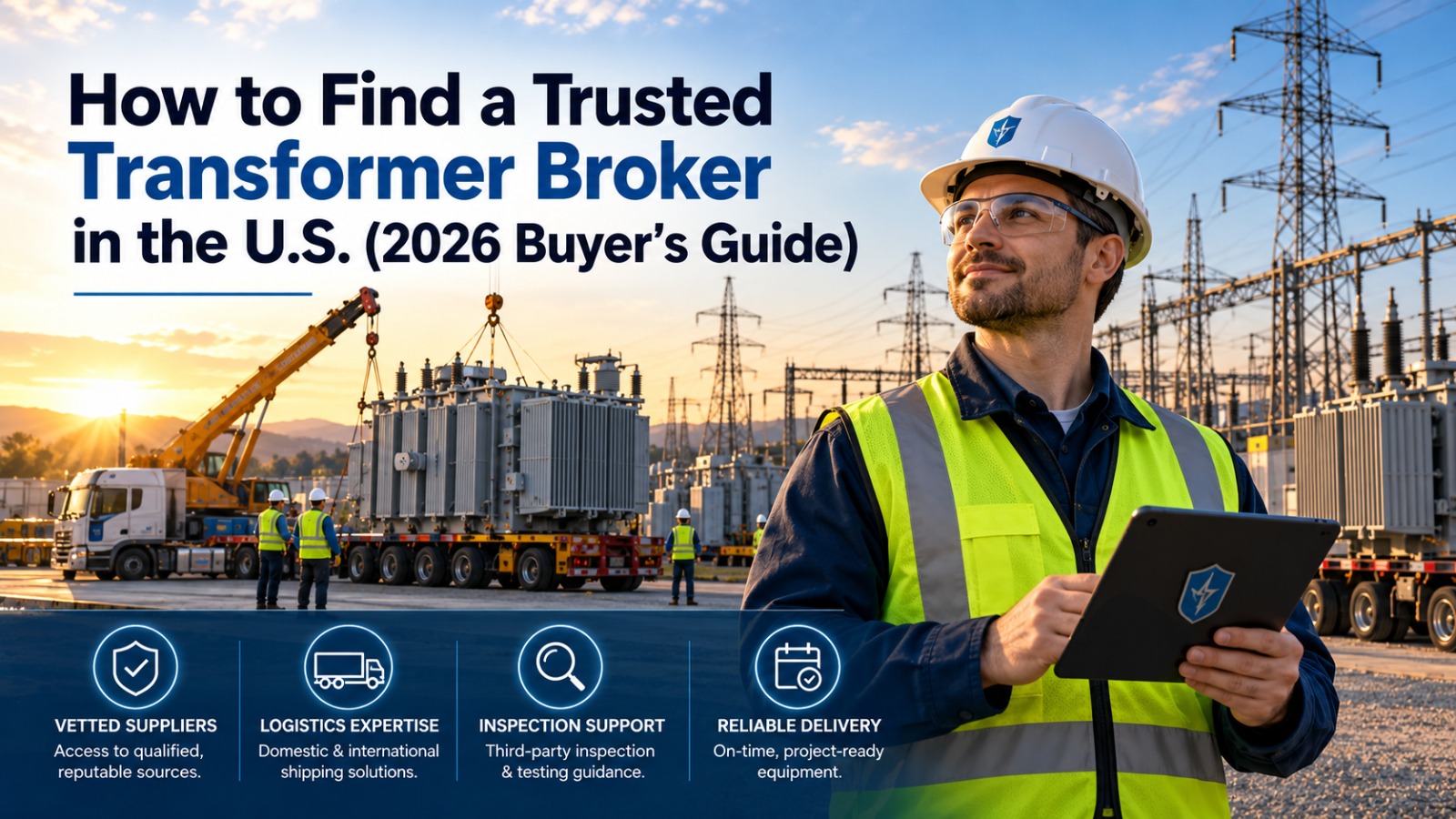
Why Buyers Use Brokers Instead of Going Direct
Manufacturer lead times for power and distribution transformers have stretched well past a year in many voltage classes, driven by steel core shortages and surging demand from data centers, EV infrastructure, and grid modernization projects. A broker with an active surplus and secondary-market network can often deliver in weeks, not quarters — which matters when a failed transformer is holding up a commissioning date or causing an outage.
This isn’t unique to transformers either. The same sourcing logic applies across the electrical equipment supply chain — switchboards and switchgear, DC combiner boxes, and even gas and industrial turbines all face similar backlog pressure, which is why project developers increasingly work with a single power equipment broker rather than chasing manufacturers individually for every line item.
How to Vet a Transformer Broker: 6 Things to Check
- Ask for test reports, not just photos. A legitimate broker will provide factory or field test data (dielectric, turns ratio, insulation resistance) — not just a nameplate photo and a price.
- Confirm they can source across categories, not just one SKU. Projects rarely need only a transformer. If the same broker can also supply solar PV modules, EV chargers, or battery storage equipment, it usually signals real industry relationships rather than a single reseller flipping one warehouse.
- Check their track record with utility-scale and commercial buyers. A broker that regularly works with utilities, EPCs, and industrial clients will understand interconnection requirements and won’t need to be walked through basic specs.
- Ask about warranty and return terms on surplus units. Reputable brokers stand behind refurbished or surplus equipment with a warranty period — even a short one is a strong signal of confidence in the unit’s condition.
- Get a straight answer on lead time. “We’ll check and get back to you” for three weeks is a red flag. A broker with real inventory visibility can usually give you a realistic timeline within a day or two.
- Look for national reach. Regional shortages are common. A national equipment broker with sourcing relationships across multiple states has more paths to find your exact spec than a broker limited to one region.
Frequently Asked Questions
Is buying a transformer through a broker more expensive than buying direct from a manufacturer? Not usually. Brokers often source surplus or secondary-market units at a lower cost than new manufacturer pricing, and the savings on lead time (avoiding project delay costs) frequently outweigh any markup.
Can a transformer broker source refurbished units that meet current safety standards? Yes — reputable brokers test and certify refurbished transformers against relevant ANSI/IEEE standards before resale, and provide documentation to support utility interconnection and inspection requirements.
What information do I need to give a broker to get an accurate quote? At minimum: voltage class (primary/secondary), kVA or MVA rating, phase (single or three), cooling type (e.g., ONAN, ONAF), and intended application (substation, distribution, renewable interconnection, etc.).
How fast can a broker typically deliver compared to a manufacturer? Depending on the spec and current surplus inventory, brokers can often deliver in a matter of weeks, versus 12+ months for new manufacturer orders in many voltage classes as of 2026.
Final Thoughts
The right transformer broker doesn’t just fill a spec sheet — they reduce project risk by verifying equipment condition, handling logistics, and giving you a realistic timeline upfront. If your project also touches switchgear, combiner boxes, battery storage, or renewable equipment, working with one broker who covers the full electrical equipment supply chain can simplify sourcing considerably.
Need a Transformer Sourced Fast?
Don’t let a backordered transformer stall your project. Get a quote from Unicorn Solar’s sourcing team today and get straight answers on availability, pricing, and realistic lead times — no waiting weeks for a callback.
