
Most people spend weeks researching which solar company to hire and almost no time understanding what goes into the system itself. By the time a salesperson walks you through a proposal, the equipment decisions are already made and you are approving choices you do not fully understand.
That is where problems start. Solar energy equipment is not a single product. It is a collection of components that must work together correctly for the system to perform as promised. Knowing the right questions to ask about each solar power system component up front is what separates a well-performing system from a costly disappointment over 25 years.
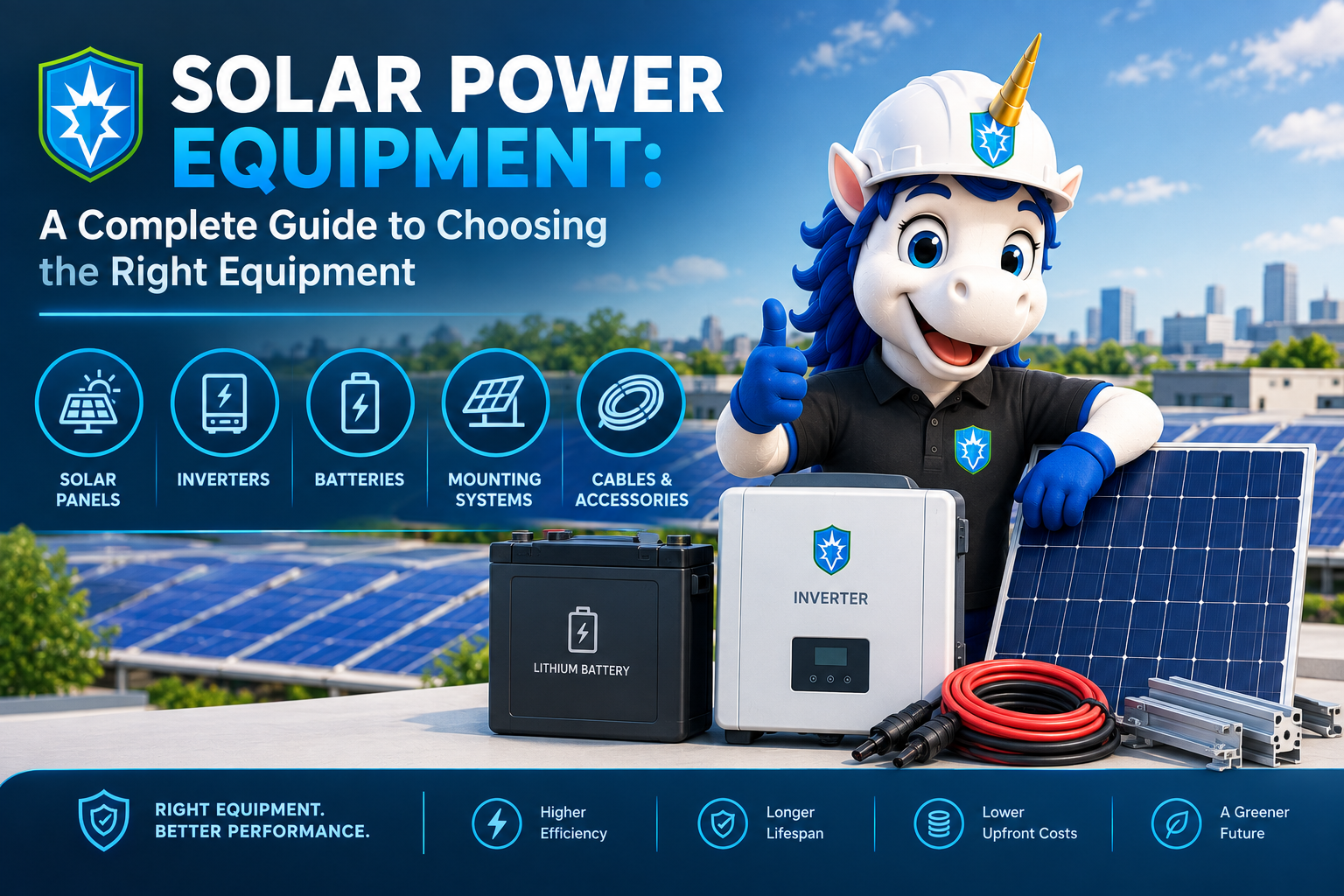
What Solar Power Equipment Actually Consists Of
A solar energy system is made up of several distinct components, each with its own quality range, warranty terms, and compatibility requirements. Understanding what each one does is the starting point for making a smart purchasing decision.
Solar panels are the most visible part of the system and the component most buyers focus on first. They convert sunlight into direct current electricity. Panel quality varies significantly across manufacturers, and spec sheets alone do not tell you everything. Cell type, temperature coefficient, degradation rate, and whether the manufacturer has a stable supply chain all affect real-world performance.
Inverters convert the direct current from your panels into the alternating current your home or business actually uses. This is one of the most critical solar power system components because inverter failure affects your entire system output. String inverters handle the whole array centrally. Microinverters work at the individual panel level, which reduces the impact of any single failure.
Racking and mounting systems hold the panels in place against wind, snow, and thermal expansion over decades. Cheap racking is one of the most common places where costs are cut invisibly. A racking failure is expensive to repair and can void roof warranties in the process.
Monitoring systems track your system’s output in real time and flag underperformance before it becomes a long-term loss. This component is often treated as optional but is one of the most practically useful parts of any solar installation.
Why Getting Equipment Wrong Costs More Than You Think
A solar installation typically has a payback period of 7 to 12 years, and that math only works if the equipment performs close to specification across that entire window. A panel with a higher degradation rate than quoted, an inverter that fails outside its warranty period, or racking undersized for local wind loads can each add thousands in unexpected costs.
The exposure is not just in the repair cost. It is in the production loss while the problem goes undetected, which is why low-quality solar panel equipment that passes initial inspection can still be a poor investment over time.
Choosing Solar Equipment for Homes vs. Commercial Projects
The right equipment depends heavily on the application. Solar equipment for homes typically involves smaller systems with different efficiency priorities than commercial or utility-scale installations.
For Commercial buyers, panel efficiency matters more when roof space is limited, since higher efficiency panels produce more output per square foot. For commercial buyers with large roof areas or ground-mount space, slightly lower efficiency at a meaningfully better price per watt is often the smarter trade-off.
Inverter choice also differs by application. Microinverters are common in commercial solar because partial shading from trees or chimneys is typical. String inverters are more common in commercial installations where shading is minimal and cost per watt matters across a larger system.
Battery storage decisions are more nuanced for homes than for commercial projects. Homeowners often prioritize backup power. Commercial buyers typically prioritize demand charge reduction, which requires different capacity and control configuration.
What to Actually Check When Evaluating Solar Panel Equipment
Tier 1 manufacturer status is a commonly referenced benchmark. Tier 1 manufacturers are Bloomberg-tracked with consistent production quality. It is not a quality guarantee on its own, but it is a meaningful filter.
Degradation rate is how much output a panel loses per year. Most degrade around 0.5% annually. Lower is better, and the difference compounds significantly over 25 years.
Temperature coefficient measures how much output drops as the panel heats up. In warm climates, this figure matters more than peak efficiency, since panels operate at high temperatures in the real world.
Warranty structure should cover both product defects and performance guarantees separately. A 25-year warranty means nothing if the manufacturer is unlikely to be operating to honor it.
Common Mistakes When Buying Solar Power Equipment
Choosing panels based on efficiency alone ignores degradation rate, temperature performance, and supply chain reliability, all of which affect real output more than a single percentage point of peak efficiency.
Accepting the inverter that comes bundled without asking about it separately is a missed opportunity. Inverter brands and warranty terms vary widely, and inverters are statistically the component most likely to need replacement during a system’s lifetime.
Overlooking racking quality because it is not visible is common. Ask what racking brand and load rating will be used and verify it matches your local wind and snow conditions.
Ignoring monitoring because the system appears to be working is how underperformance goes undetected for months and sometimes years.
FAQs About Solar Power Equipment
What are the main solar power system components?
The primary components are solar panels, an inverter, racking and mounting hardware, and a monitoring system. Battery storage is optional but increasingly common, particularly for solar equipment for homes seeking backup power capability.
Does panel efficiency matter most when choosing solar panel equipment?
Efficiency matters more when roof space is limited. For larger installations with adequate space, degradation rate and long-term manufacturer reliability often matter more than peak efficiency numbers.
What makes solar equipment for homes different from commercial equipment?
Commercial systems often prioritize efficiency per square foot and microinverters for shading tolerance. Commercial systems typically prioritize cost per watt across larger arrays with string inverter architecture.
How long should solar energy equipment last?
Panels typically carry 25-year performance warranties. Inverters generally last 10 to 15 years. Racking and mounting systems should last the life of the panels when correctly sized and installed.
What is the most important thing to verify about equipment sourcing?
Whether the equipment comes through an authorized distribution channel with a valid, enforceable manufacturer warranty. The same brand can have different warranty validity depending on which supply chain it came through.
The Bottom Line
Choosing the right solar power equipment is not about picking the most recognized brand or the highest efficiency on a spec sheet. It is about understanding how each solar power system component affects long-term performance, matching equipment to your specific site, and verifying that every piece of solar energy equipment you buy is backed by a warranty you can actually enforce.
Source Equipment You Can Actually Verify
If you are an installer or developer who wants verified solar panel equipment documentation and authorized supply chain sourcing for every project, Unicorn Solar can help. Reach out at unicorn-sd.contact-us for a free consultation on sourcing the right equipment with full traceability.
