
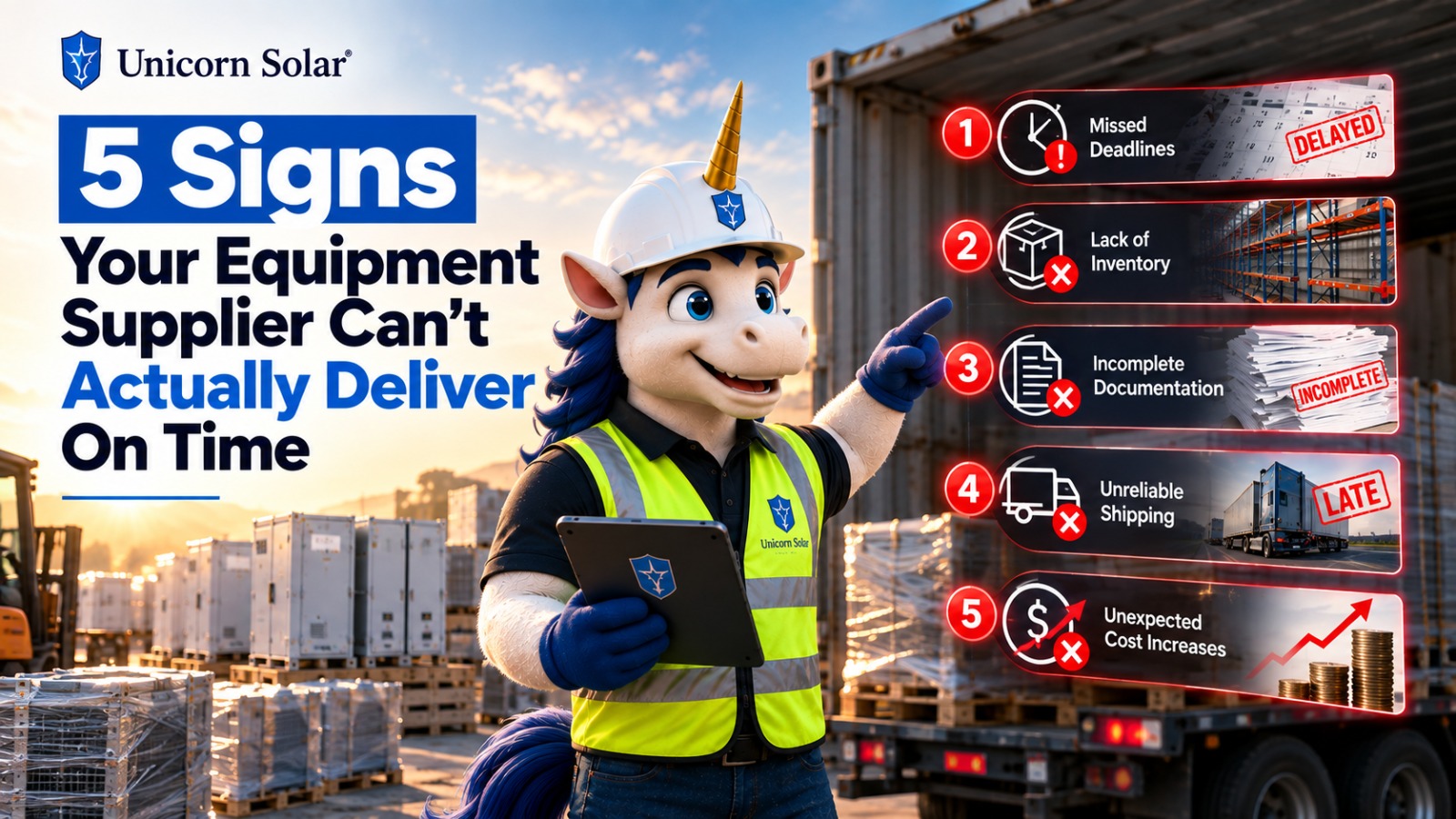
Every equipment supplier sounds reliable at the quoting stage. The real test comes later — when a delivery date approaches and either the truck shows up or it doesn’t. Contractors searching for a “power equipment supplier near me” or a “solar equipment broker near me” are usually trying to solve for exactly this: finding someone who can actually hit the timeline they’re quoting, not just the lowest price on paper. Here are five warning signs that show up before a missed delivery date does — and what to check instead.
1. They Can’t Give You a Specific Date — Only a Range
“Somewhere between 8 and 16 weeks” isn’t a delivery date, it’s a guess dressed up as one. Suppliers with real inventory visibility — whether it’s transformers, switchgear, or solar modules — can usually narrow that down to a specific week once they check actual stock and production status. If every answer comes back as a wide range that never tightens up as the order date approaches, that’s usually because they don’t actually know, not because the industry is unpredictable across the board.
What to check instead: Ask when the date will firm up, and hold them to that follow-up. A supplier with real visibility will commit to narrowing the window; one without it will keep giving you the same vague range every time you ask.
2. They Only Work With One Manufacturer
A supplier tied to a single manufacturer has no fallback when that manufacturer’s production queue slips — and in 2026, slippage has become the norm rather than the exception across transformers, switchgear, turbines, and solar modules. If your supplier can’t tell you what happens when their primary source falls through, they probably don’t have a backup plan.
What to check instead: Ask directly whether they source from multiple manufacturers or maintain surplus/secondary-market inventory. A broker with access across transformers, switchgear, solar PV modules, and battery storage has more paths to your spec than a single-source reseller.
3. They Won’t Provide Documentation Before You Pay
Legitimate suppliers can produce test reports, certification documents, and unit history before money changes hands. If a supplier is cagey about paperwork — “we’ll send it with the shipment” — that’s often a sign either the documentation doesn’t exist yet or the equipment’s condition isn’t what’s being represented.
What to check instead: Request test reports and certification (UL listing, relevant IEEE/ANSI standards depending on the equipment) as a condition of the order, not an afterthought.
4. They Can’t Answer Questions About Your Specific Site or Spec
A supplier who gives the same generic pitch regardless of your voltage class, site conditions, or project scope usually isn’t actually checking inventory against your requirements — they’re quoting off a catalog. Searching “equipment broker near me” often turns up suppliers like this: locally convenient, but not necessarily equipped to match a specific technical spec.
What to check instead: Ask a spec-specific question — voltage class, kVA rating, connector type, certification standard — and see whether the answer is specific or generic. A supplier who asks clarifying questions back is usually the one actually checking real availability.
5. Past Customers Mention the Same Problem
One bad review can be an outlier. A pattern of complaints about missed dates, unresponsive communication once an order is placed, or “we’ll get back to you” that never resolves is a much stronger signal. This is one of the easiest things to check before committing — and one of the most commonly skipped.
What to check instead: Ask for references from recent projects similar in scope to yours, not just a general testimonial. A supplier confident in their delivery track record will provide them without hesitation.
Why This Matters More Than It Used To
Lead times across nearly every category of power and solar equipment have stretched significantly, which means the cost of choosing the wrong supplier has gone up too. A missed delivery date on a transformer or switchgear order doesn’t just delay one line item — it can stall an entire project, push back commissioning, and in some cases jeopardize time-sensitive incentive eligibility. Vetting a supplier properly before committing a budget is cheaper, in nearly every case, than discovering these five signs after the order is already placed.
Working with a national equipment broker rather than a single regional supplier also widens your options — instead of being limited to whoever happens to be closest, you get access to inventory and sourcing relationships across the country, which matters more than physical proximity when a specific spec is what you actually need on schedule.
A Quick Self-Check Before You Sign
Before finalizing an order — whether you’re comparing a local option to a “power equipment broker near me” search result or evaluating a national supplier — run through this short list:
- Do they give a specific week, or a shifting range?
- Can they name a backup sourcing path if their primary order slips?
- Will they send certification and test documentation before payment?
- Do they ask about your specific spec, or recite a generic pitch?
- Can they provide references from a comparable recent project?
If the answer to more than one of these is no, it’s worth getting a second quote before committing — even if it adds a day or two to your procurement timeline. That’s a much smaller cost than discovering the same gaps after the order is already placed and the project is waiting on it.
Frequently Asked Questions
How do I find a reliable equipment supplier near me? Proximity matters less than sourcing reach and documentation practices. Look for a supplier or broker who can provide specific delivery dates, certification documents before purchase, and references from recent projects — regardless of whether they’re local or national.
What’s the difference between a regional supplier and a national equipment broker? A regional supplier is typically limited to local inventory and manufacturer relationships, while a national broker sources across multiple states and manufacturers, which usually means more options when a specific spec or timeline is critical.
Is it a red flag if a supplier can’t confirm a delivery date immediately? Not necessarily on the first call, but it becomes one if the date never firms up as the order date approaches. A supplier with real inventory visibility should be able to narrow a range to a specific week within a reasonable follow-up period.
Should I ask for references before placing a large equipment order? Yes. References from recent, similarly-scoped projects are one of the most reliable ways to verify whether a supplier’s delivery promises hold up in practice, not just on paper.
Can a broker guarantee delivery dates that manufacturers can’t? No supplier can guarantee against every possible disruption, but a broker with multi-manufacturer and surplus-market access generally has more flexibility to work around a single production delay than a supplier tied to one manufacturer.
Final Thoughts
Most missed delivery dates aren’t surprises — they’re the predictable result of warning signs that were visible at the quoting stage and got overlooked. Checking for specific dates, multi-source sourcing, upfront documentation, spec-level knowledge, and a clean track record before committing a budget is the difference between a project that stays on schedule and one that stalls waiting on a truck that was never coming on time.
Looking for an equipment supplier who can actually hit your timeline? Get a quote from Unicorn — solar, transformers, switchgear, EV chargers, turbines, and battery storage sourced nationwide, with straight answers on availability before you commit.
