
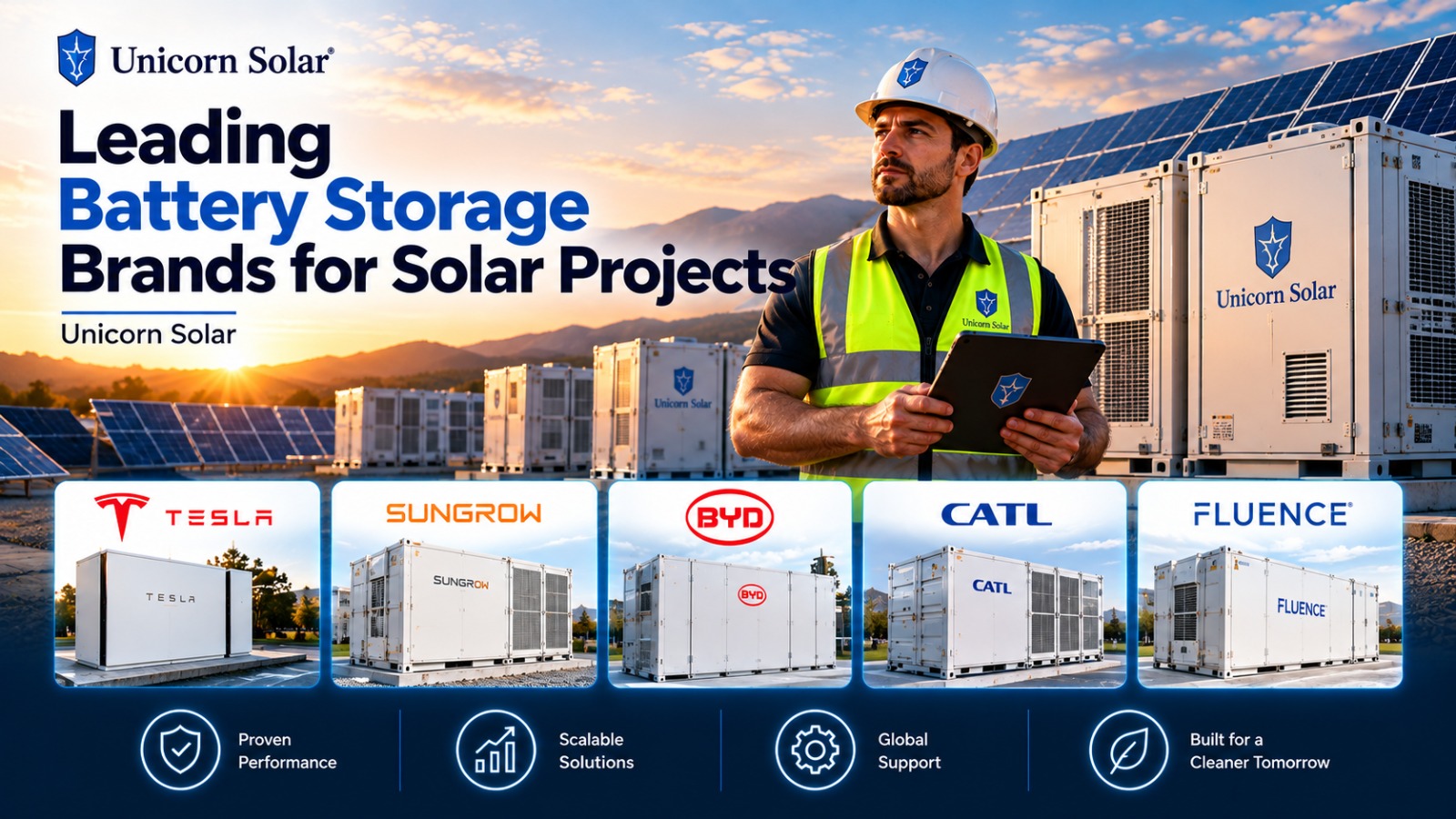
Choosing a battery storage brand is one of the decisions that shapes a solar project’s performance for the next 10-15 years, not just its upfront cost. Chemistry, warranty terms, software integration, and manufacturer track record all vary enough between brands that the “best” choice really depends on the specific project — commercial or utility-scale. Here’s a look at the brands currently leading the market, and what actually separates them.
What Determines a “Leading” Battery Storage Brand
Before naming names, it’s worth being clear on what actually separates a strong battery storage brand from the rest of the field:
- Cycle life and degradation rate — how many charge cycles the battery can handle before capacity meaningfully drops
- Warranty length and terms — typically 10 years is the current industry standard, but the fine print on degradation guarantees varies
- Chemistry — most leading commercial brands have moved to lithium iron phosphate (LFP) for its safety and longevity advantages over older lithium-ion chemistries
- Software and monitoring integration — how well the system works with existing solar inverters, energy management platforms, or utility demand-response programs
- Manufacturer track record and supply stability — a strong spec doesn’t matter much if the brand can’t actually deliver on a project timeline
The Brands Leading the Market
Tesla Powerwall / Megapack: Tesla remains one of the most recognized names in battery storage, with the Megapack line built specifically for utility-scale deployments and the Powerwall used in some light commercial applications. Strong brand recognition and an established installer network are among its biggest advantages.
LG Energy Solution (RESU line): LG’s RESU series has a long track record in commercial storage, known for compact form factors and broad compatibility with third-party inverters, which makes it a common choice for retrofits.
BYD Battery-Box: BYD has built a strong reputation particularly in commercial systems, with modular battery designs that let installers scale capacity to a project’s specific needs rather than fixed-size units.
Enphase IQ Battery: Enphase’s battery systems are built around tight integration with its own microinverter ecosystem, making it a popular choice for projects already using Enphase solar equipment.
Sonnen: Sonnen has positioned itself around long cycle life and strong software for energy management, with a particular focus on maximizing self-consumption and backup reliability.
Generac PWRcell: Generac brings its backup power heritage into the battery storage space, often chosen for projects prioritizing seamless backup power functionality alongside solar integration.
Panasonic’s storage systems benefit from the company’s long history in battery cell manufacturing and are frequently selected for projects prioritizing established manufacturing scale and reliability.
Why Brand Alone Isn’t the Full Picture
Even with a clear brand preference, availability has become as important as the spec sheet itself. Battery storage lead times have stretched across nearly every manufacturer in 2026, driven by cell production capacity that hasn’t kept pace with demand from solar-plus-storage, EV manufacturing, and grid-scale projects all competing for the same supply. A brand that’s technically the best fit for a project doesn’t help much if it’s backordered past the project’s commissioning date.
This is where sourcing strategy matters as much as brand selection. Unicorn Solar works across multiple leading battery storage equipment brands rather than being tied to a single manufacturer, which means a project isn’t locked into one brand’s production queue. If a first-choice brand is backordered, there’s usually a comparable spec available from another leading manufacturer without forcing a redesign of the system.
That same sourcing approach extends across the rest of a solar project too — solar PV modules, DC combiner boxes, and the transformers or switchgear larger systems need, all sourced through one point of contact instead of separate vendors per component.
What Working With Unicorn Solar Actually Looks Like
For developers and contractors comparing brands, the process with Unicorn Solar typically starts with the project’s actual requirements — expected cycling, backup needs, existing inverter setup, and timeline — rather than pushing a single preferred brand. From there, Unicorn Solar checks real-time availability across its manufacturer network and quotes options that fit both the technical spec and the project’s schedule, including certification and warranty documentation upfront rather than as an afterthought.
That approach matters most when a project hits a snag partway through procurement — a brand goes on backorder, a spec gets revised, or a timeline moves up. Because Unicorn Solar isn’t tied to one manufacturer, adjusting the sourcing plan doesn’t mean starting the vetting process over from scratch.
How to Choose the Right Brand for Your Project
- Match chemistry and cycle life to your use case. Daily cycling for self-consumption has different requirements than infrequent backup-only use.
- Check real-world warranty claims processes, not just the stated term. A 10-year warranty means little if claims processing is slow or the manufacturer’s support network is thin.
- Confirm inverter and monitoring compatibility before committing. Some brands integrate tightly with specific inverter ecosystems; others are more agnostic.
- Weigh availability alongside specs. The technically ideal brand isn’t the right choice if its lead time blows the project’s commissioning deadline.
Frequently Asked Questions
What is the most reliable battery storage brand for solar projects? Reliability depends on the specific application — Tesla, LG Energy Solution, BYD, Enphase, Sonnen, and Panasonic all have strong track records, but the right choice depends on cycle requirements, existing inverter compatibility, and project scale.
Does Unicorn Solar source battery storage from multiple brands? Yes. Unicorn Solar sources battery storage equipment across several leading manufacturers rather than a single brand, which allows for spec flexibility if a first-choice brand faces availability delays.
Is lithium iron phosphate (LFP) better than older lithium-ion battery chemistry for solar storage? LFP has become the industry standard for most new commercial battery storage systems due to its improved safety profile and longer cycle life compared to older lithium-ion chemistries, though it typically has a slightly lower energy density.
How long do solar battery storage systems typically last? Most leading brands offer 10-year warranties, with expected usable life often extending beyond that depending on cycling frequency and depth of discharge, though actual performance varies by chemistry and usage pattern.
Can Unicorn Solar help if my preferred battery brand is backordered? Yes — because Unicorn Solar sources across multiple manufacturers, a backordered brand doesn’t have to stall a project. A comparable spec from another leading brand can often be identified to keep the project on schedule.
Final Thoughts
The leading battery storage brands on the market today all have genuine strengths, and the right pick depends on your project’s specific requirements more than any single brand being universally “best.” What matters just as much is working with a source that can actually deliver the chosen brand — or a comparable alternative — on your project’s timeline.
Comparing battery storage brands for an upcoming solar project? Talk to Unicorn Solar about availability, pricing, and lead times across leading manufacturers.
