
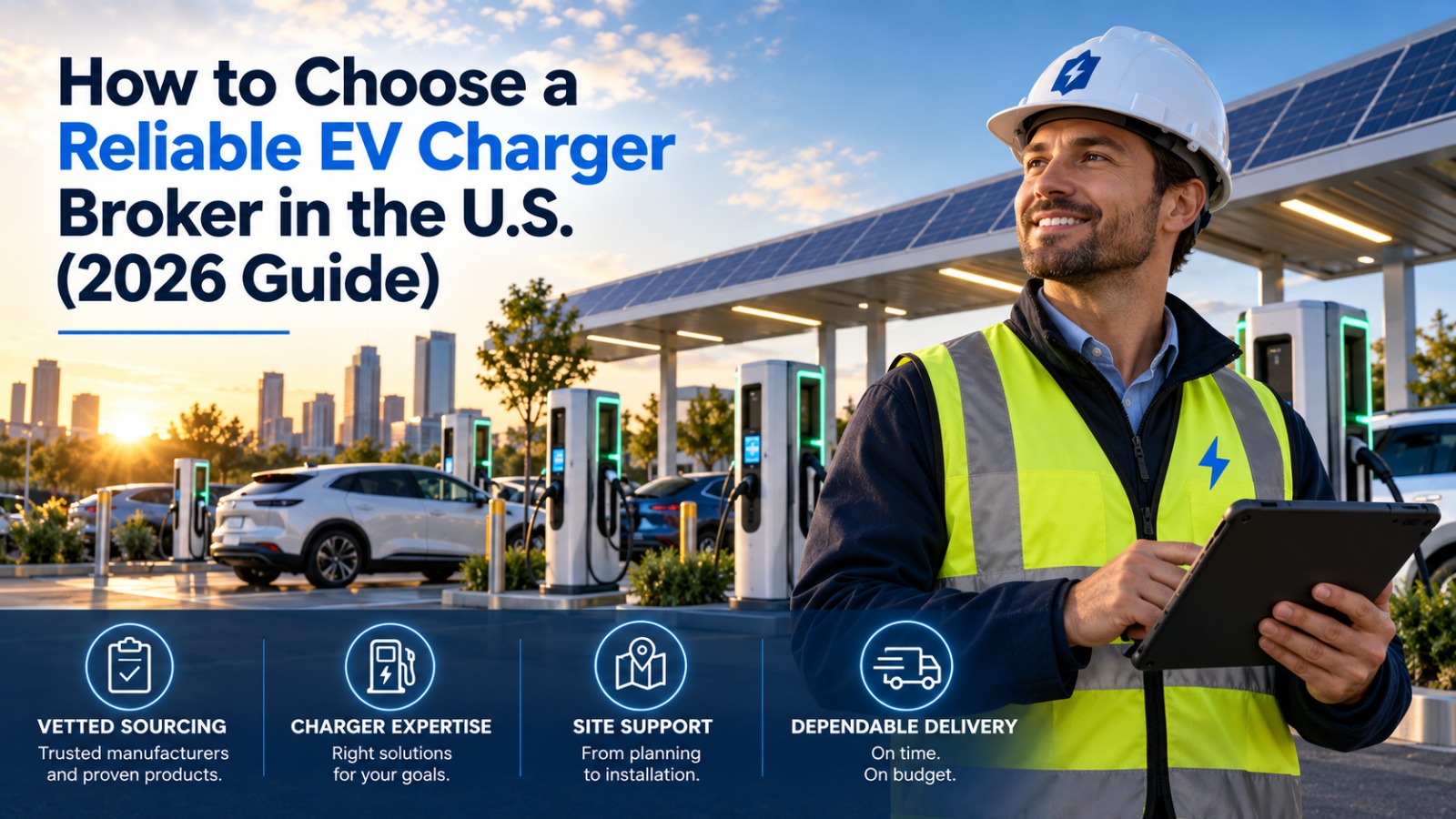
EV charging infrastructure demand has outpaced supply chains across almost every category: Level 2 stations, DC fast chargers, connectors, transformers to power them, and the switchgear to tie it all together. Fleet operators, property developers, and utilities racing to meet deployment deadlines are increasingly finding that manufacturer lead times alone won’t get a project done on schedule. That’s driving more buyers toward EV charger brokers — specialists who can source equipment across multiple manufacturers and secondary markets to close the gap.
This guide covers what an EV charger broker actually does, why they matter right now, and exactly what to check before choosing one.
What Does an EV Charger Broker Do?
An EV charger broker sits between buyers and the wider charging-equipment ecosystem — OEMs, distributors, surplus sellers, and decommissioned or recalled inventory that’s still fully usable. Rather than one buyer negotiating separately with every manufacturer, a broker already has standing relationships and live inventory visibility, which shortens the sourcing timeline considerably.
Typical broker services include:
- Sourcing — matching your project spec (Level 2 vs. DC fast charging, connector type, network compatibility, power output)
- Vetting — confirming certifications (UL, NEC compliance), warranty status, and unit condition
- Bulk and multi-site coordination — critical for fleet depots, retail rollouts, or multi-family housing developments needing dozens of units at once
- Logistics — freight, staging, and delivery scheduling to match installation timelines
- Cross-category bundling — pairing chargers with the electrical infrastructure needed to actually run them
Why Buyers Are Turning to Brokers in 2026
Two forces are colliding: federal and state EV infrastructure incentives are pushing deployment timelines forward, while chip shortages and freight bottlenecks have kept charger and component lead times unpredictable. A broker with an active secondary-market network can often assemble the volume a project needs faster than waiting on a single manufacturer’s production queue.
It rarely stops at the charger itself, either. Every DC fast charging site typically needs supporting infrastructure — often a dedicated transformer, sometimes new switchboards and switchgear, and increasingly battery storage equipment to manage peak demand charges. Sourcing all of it through one power equipment broker instead of juggling separate vendors for each component tends to cut both cost and coordination time.
How to Vet an EV Charger Broker: 7 Things to Check
- Confirm certifications up front. Every unit should carry a valid UL listing and meet current NEC requirements. A broker unwilling to provide certification documents before purchase is a red flag.
- Ask whether they can supply at project scale. A single charger and a 50-unit fleet depot rollout are very different sourcing problems. Ask directly whether they’ve handled orders at your volume before, and ask for references if it’s a large deployment.
- Check network and software compatibility. Chargers need to work with the intended charging network’s software (OCPP compliance, billing integration, etc.). A good broker will ask about this before quoting, not after delivery.
- Look at warranty terms on refurbished or surplus units. Surplus chargers can be a smart way to cut costs, but only if backed by a real warranty period — not sold “as-is” with no recourse.
- Ask about supporting electrical infrastructure. If the broker can also source solar PV modules or DC combiner boxes for solar-plus-charging sites, that’s a strong signal they understand the full site design, not just the charger unit.
- Get a firm delivery timeline in writing. Vague timelines (“a few weeks, probably”) cause missed incentive deadlines. A broker with real inventory access can commit to a specific window.
- Verify national sourcing reach. Regional supply gaps are common with EV equipment. A national equipment broker with cross-state relationships has more paths to your exact spec than a regional-only reseller.
What Affects EV Charger Pricing Through a Broker?
Pricing varies more than most buyers expect, and understanding the main cost drivers helps you evaluate whether a quote is fair:
- Charger type and power output — DC fast chargers cost significantly more than Level 2 units, and pricing scales with kW output within each category
- New vs. refurbished/surplus — surplus units in good condition with valid certification can run well below new list price
- Order volume — bulk fleet or multi-site orders typically unlock per-unit discounts that single-unit purchases don’t
- Network licensing — some chargers require ongoing software/network subscription costs separate from the hardware price
- Freight and staging — oversized DC fast charger cabinets can carry meaningful freight costs depending on distance and site access
A transparent broker will break these line items out clearly rather than bundling everything into one number that’s hard to compare against other quotes.
Red Flags to Watch For
Not every broker in this space operates the same way, and a few warning signs are worth taking seriously:
- No willingness to provide certification paperwork before payment — this should never be a “we’ll send it after” situation
- Pressure to commit before you’ve seen unit-level documentation — legitimate suppliers expect buyers to verify before purchasing
- Vague answers about site compatibility — a broker who doesn’t ask about your site’s electrical capacity, network requirements, or intended use case likely isn’t scoping the order correctly
- No physical inventory or sourcing network to point to — ask where the equipment is actually coming from; a broker should be able to explain their supply chain, not just quote a price
Taking the time to check these upfront is far cheaper than discovering a problem after equipment has shipped.
Frequently Asked Questions
Is it cheaper to buy EV chargers through a broker than directly from a manufacturer? Often yes. Brokers can access surplus, refurbished, or bulk-discounted inventory that isn’t available at list price, and the time saved by avoiding long manufacturer queues can offset project delay costs that are far more expensive than any broker markup.
Can a broker source both Level 2 and DC fast chargers? Yes — reputable EV charger brokers typically carry or can source both categories, along with connectors, cabling, and mounting hardware needed for a full installation.
Do brokered EV chargers come with a warranty? Reputable brokers back refurbished and surplus units with a warranty period, and new units typically retain manufacturer warranty coverage. Always confirm warranty terms in writing before purchase.
What information should I give a broker to get an accurate EV charger quote? At minimum: charger type (Level 2 or DC fast), quantity needed, connector standard (CCS, NACS, etc.), required power output, network/software requirements, and site electrical capacity.
How fast can a broker typically deliver EV charging equipment compared to ordering direct? Depending on current surplus and secondary-market inventory, brokers can often deliver in weeks rather than the several-months-plus lead times common with direct manufacturer orders in 2026.
Final Thoughts
Choosing the right EV charger broker isn’t just about finding the lowest unit price — it’s about finding a partner who understands certification requirements, network compatibility, and the supporting electrical infrastructure your site actually needs. For multi-site or fleet deployments especially, working with one broker who can bundle chargers with transformers, switchgear, and battery storage tends to simplify the entire project.
Planning an EV charging deployment? Get a sourcing quote from Unicorn Solar & Diesel’s EV charger team and get clear answers on availability, certification, and delivery timelines — no runaround.
