
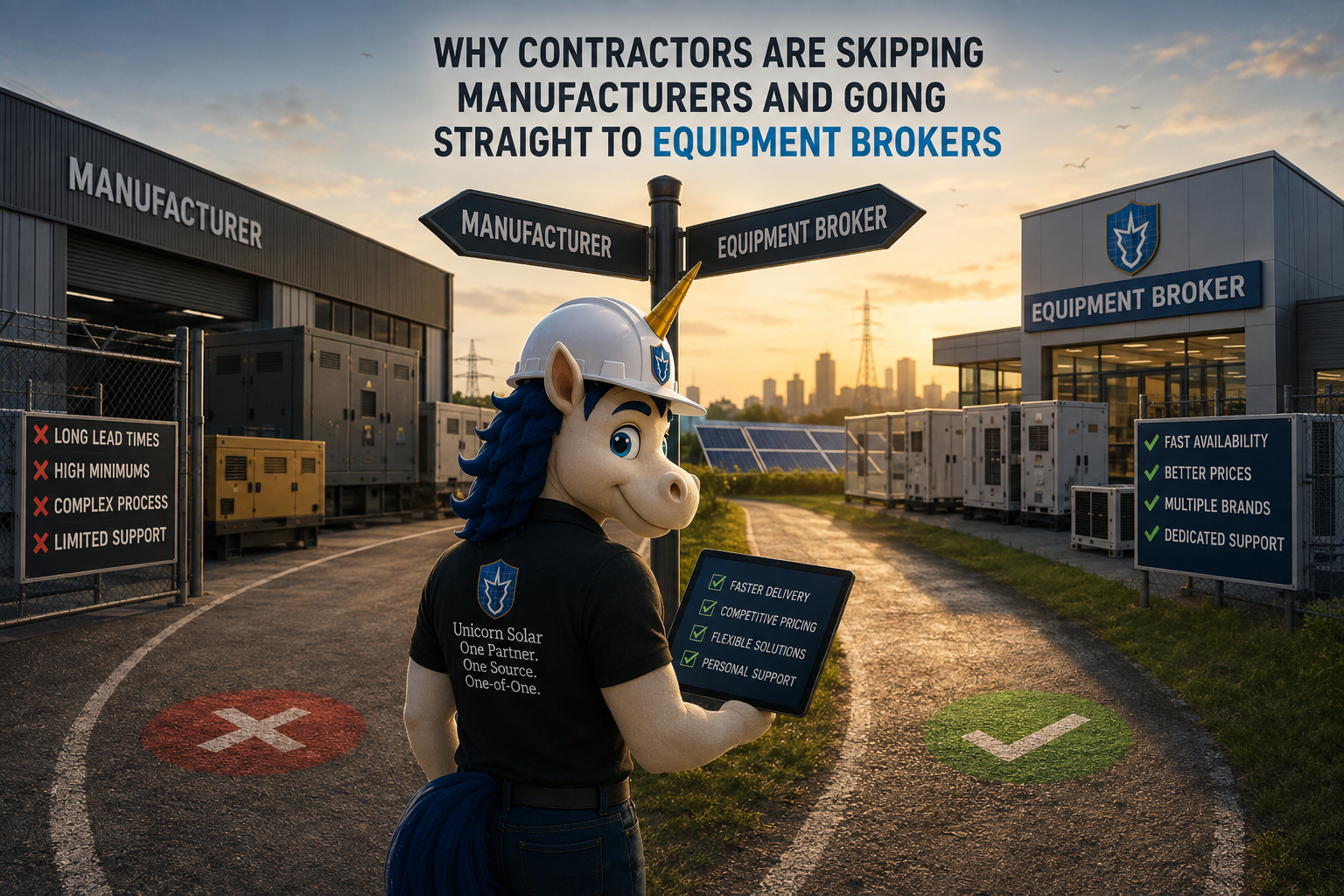
A few years ago, ordering directly from the manufacturer was the default move for most contractors and project developers. It was predictable: you picked a spec, placed an order, and waited. That model is breaking down. Across solar, power distribution, and EV infrastructure projects, more contractors are now going straight to equipment brokers first — not as a fallback, but as the primary sourcing strategy. Here’s what’s driving that shift, and why it’s likely to stick.
The Manufacturer Backlog Problem
Lead times across almost every category of electrical and power equipment have stretched well beyond what they were even a few years ago. Transformers, switchgear, solar modules, and EV charging hardware have all seen demand spike — driven by grid modernization, data center buildouts, and renewable energy deployment — while manufacturing capacity hasn’t kept pace. The result: 12+ month waits are now common for equipment that used to ship in weeks.
For a contractor with a fixed project deadline, a financing timeline, or a client who’s already scheduled commissioning, that kind of delay isn’t just inconvenient — it can blow through the entire project budget in penalty clauses and idle labor. Subcontractors sitting idle waiting on a single transformer or switchgear lineup, financing costs accruing while equipment sits on backorder, and clients pushing back commissioning dates all add up to real money — often more than the cost difference between a manufacturer order and a broker-sourced unit.
What a Broker Actually Solves
An equipment broker isn’t a middleman adding a markup for no reason — the value is in what they already have that a single contractor doesn’t: standing relationships across manufacturers, distributors, and the secondary market, plus real-time visibility into what’s actually available right now versus what’s theoretically in a catalog.
That translates into three concrete advantages:
- Speed — sourcing from surplus, decommissioned, or multi-vendor inventory instead of waiting on a single production queue
- Flexibility — access to refurbished or surplus units at a lower cost when a brand-new unit isn’t strictly necessary
- Simplicity — one point of contact instead of managing quotes and timelines across a dozen manufacturers for a single project
It’s Rarely Just One Component
The other reason contractors are consolidating through brokers: modern projects almost never need just one type of equipment. A solar-plus-storage installation might need solar PV modules, a transformer, DC combiner boxes, and battery storage equipment — all coordinated to the same installation timeline. An EV charging site typically needs EV chargers alongside supporting switchboards and switchgear. A backup power project might route through turbines entirely.
Sourcing each of those from a different manufacturer means managing separate quotes, separate lead times, and separate points of failure. Working with one power equipment broker that covers the full range collapses that into a single coordinated order — which is often the bigger time savings, more than any single component’s lead time.
How Contractors Are Adjusting Their Sourcing Strategy
The shift shows up in a few consistent patterns across the industry:
- Getting broker quotes before manufacturer quotes, not after, to establish a realistic timeline baseline
- Building surplus and refurbished equipment into project budgets from the start, rather than treating it as a last-resort compromise
- Consolidating multi-category orders with a single national broker instead of managing separate vendor relationships per component
- Prioritizing documented, certified equipment over the absolute lowest price, since verified condition reduces downstream commissioning risk
What to Look for in a Broker (If You’re Making the Switch)
Not every broker operates with the same level of rigor. Before committing budget, it’s worth confirming:
- They provide test reports and certification documents before purchase, not after
- They can speak specifically to your voltage class, power rating, or site requirements — not just a generic price
- They offer warranty terms on refurbished or surplus equipment
- They can source across multiple categories relevant to your project, not just one SKU
- They have national reach, since regional supply gaps are common and a broker limited to one area has fewer paths to your exact spec
Broker vs. Manufacturer: A Quick Comparison
| Factor | Direct from Manufacturer | Equipment Broker |
| Typical lead time | Often 12+ months for transformers, switchgear, and high-demand categories | Often weeks, depending on surplus/secondary-market availability |
| Order scope | Usually one product category per vendor | Can often cover multiple categories in one order |
| Pricing flexibility | Fixed list pricing | New, refurbished, and surplus options at different price points |
| Point of contact | Separate contact per manufacturer for multi-component projects | Single point of contact across the project |
| Documentation | Standard factory documentation | Should include test reports and certification for both new and surplus units |
This isn’t an argument that brokers replace manufacturers entirely — for highly customized, long-lead-time builds with no urgency, going direct can still make sense. But for projects on a fixed timeline, or ones spanning multiple equipment categories, the comparison increasingly favors brokers.
Frequently Asked Questions
Is it riskier to buy equipment through a broker instead of directly from a manufacturer? Not inherently. The risk depends on the broker’s vetting process, not the sourcing channel itself. A broker that provides certification documents, test reports, and warranty terms carries comparable risk to a direct manufacturer purchase — often with a much shorter timeline.
Do brokers only sell used or surplus equipment? No. Most brokers offer a mix of new, refurbished, and surplus inventory, and can advise on which option fits a given budget and timeline.
Why are manufacturer lead times so long right now? Lead times across transformers, switchgear, and solar equipment have extended due to a combination of raw material constraints, higher demand from data centers and grid infrastructure projects, and renewable energy deployment outpacing production capacity increases.
Can one broker really handle sourcing for an entire project, not just one component? Yes, when the broker maintains sourcing relationships across categories. This is increasingly common as contractors consolidate vendors to reduce coordination overhead on multi-component projects like solar-plus-storage or EV charging installations.
How much faster is broker sourcing compared to ordering direct? It varies by category and current inventory, but brokers with active surplus and secondary-market access can often deliver in weeks where direct manufacturer orders would take many months.
Final Thoughts
The shift toward brokers isn’t about cutting corners; it’s a response to a supply chain that no longer matches project timelines. Contractors who build broker sourcing into their process from the start are avoiding the scheduling risk that comes with betting an entire project on a single manufacturer’s production queue.
Sourcing equipment for your next project? Talk to Unicorn about solar, transformers, switchgear, EV chargers, turbines, or battery storage — one point of contact, real availability, straight answers on timeline.
