
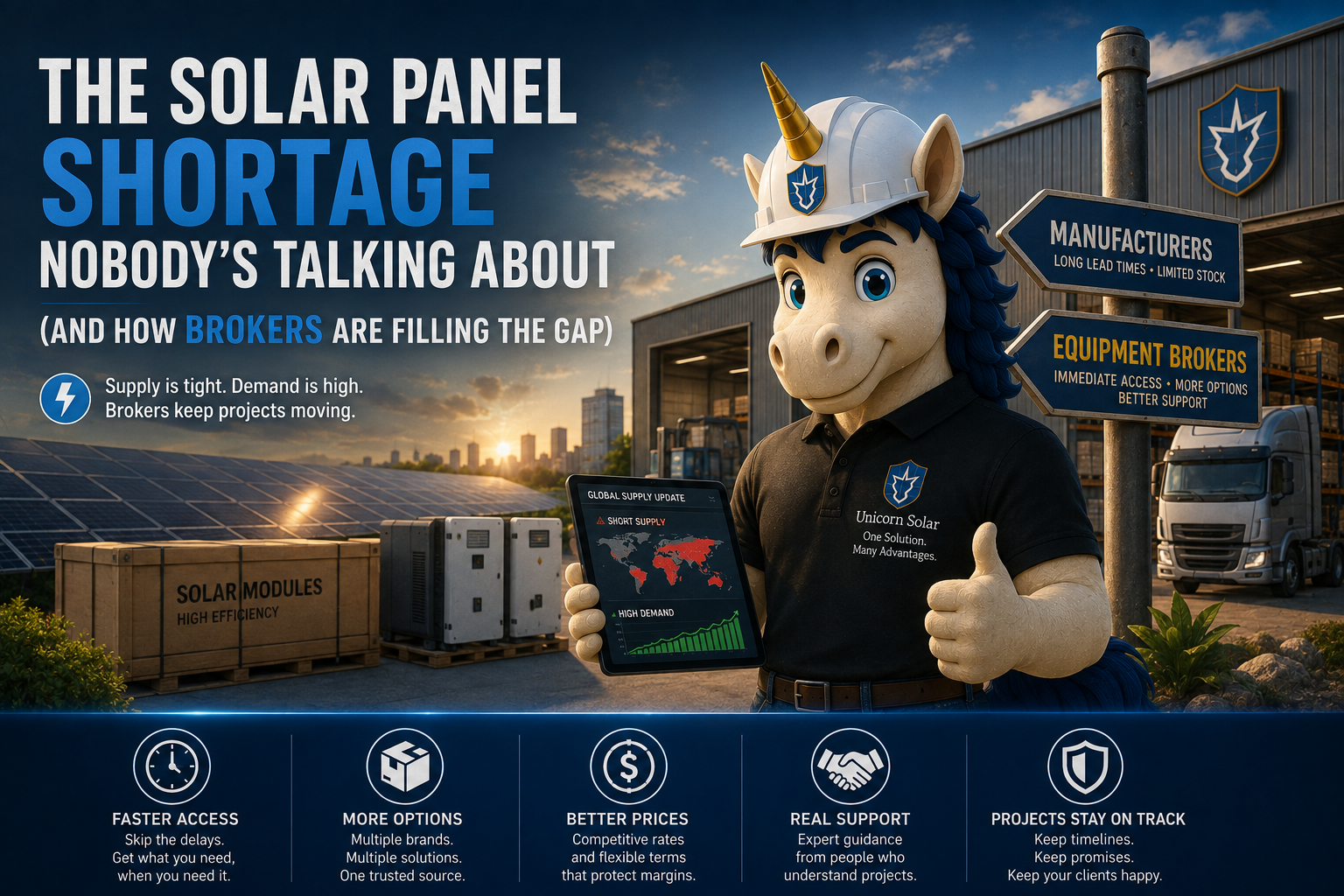
Solar has been sold as the fast, scalable answer to U.S. energy demand for years now. What doesn’t get talked about as much: getting the actual panels to a job site on schedule has become one of the hardest parts of running a solar project. Tariff changes, shifting trade policy on imported cells, and demand that’s outpacing domestic manufacturing capacity have all combined into a quieter, less-reported version of the supply crunch that hit other industries first. Developers who assumed panels would be the easy line item on their procurement list are finding out otherwise.
Why This Shortage Isn’t Making Headlines
Unlike the visible chip shortage or lumber prices during the pandemic, the solar module gap has been gradual and uneven — which is part of why it hasn’t gotten the same attention. Some manufacturers have capacity, others don’t. Some module specs are readily available; others are backordered for months. Pricing on the same wattage class can vary significantly between suppliers depending on where the cells were manufactured and which trade policies apply to them.
For a developer or EPC trying to lock in a project timeline, that unevenness is the real problem. A quote that looked solid three months ago can fall apart when the specific module you priced into the project is suddenly unavailable or has jumped in cost.
What’s Actually Driving It
A few factors are compounding at once:
- Trade policy on imported cells and modules continues to shift, affecting which products are cost-competitive and which face added duties
- Domestic manufacturing capacity is growing but hasn’t caught up to the pace of announced solar demand
- Utility-scale and commercial demand is competing directly with commercial installers for the same module allocations
- Freight and logistics bottlenecks add further delay even when product is technically available
None of these are likely to fully resolve in the near term, which means procurement strategy — not just project design is becoming a bigger part of getting solar projects built on time.
How Brokers Are Filling the Gap
This is where equipment brokers have started playing a bigger role than they used to. Instead of relying on a single manufacturer relationship, a broker with solar PV module sourcing across multiple suppliers can pull from wherever inventory actually exists — including surplus stock, overstock from canceled orders, and secondary-market panels that meet current certification standards.
That flexibility matters in two specific ways:
- Spec substitution without redesign. If your original module choice is backordered, a broker with visibility across multiple manufacturers can often find a comparable spec that doesn’t force a full engineering redesign.
- Locking pricing before it moves again. Module pricing has been volatile enough that developers who wait to source until permitting is finalized sometimes find their original budget no longer holds. Brokers who track real-time availability can often lock in pricing earlier in the project timeline.
It Connects to the Rest of the Project, Too
Solar procurement rarely stops at the panel. Most installations also need DC combiner boxes, and a growing share now pair with battery storage equipment to manage output variability and interconnection limits. Larger installations typically require a dedicated transformer and supporting switchgear as well. Sourcing all of it through one power equipment broker instead of separately chasing each component tends to keep the project timeline aligned, since the same supply chain pressure hitting panels is showing up across other categories too.
What to Ask a Solar Module Broker Before You Commit
- What certification documentation comes with the panels? UL listing and manufacturer warranty transferability should be confirmed before purchase, not after.
- Is the pricing locked, or subject to change before delivery? Given how volatile module pricing has been, get this in writing.
- Can they source a comparable spec if your first choice becomes unavailable? This is the real test of whether a broker has genuine multi-supplier access versus a single inventory pool.
- What’s the actual delivery timeline, not the best-case estimate? Ask for a realistic window based on current stock, not a theoretical one.
The Cost Trade-Off Most Buyers Miss
There’s a common assumption that broker-sourced panels must cost more than going direct, since a broker is technically an added party in the chain. In practice, the opposite is often true. Surplus and overstock inventory panels from canceled orders, discontinued product lines still within spec, or secondary-market stock — can come in below current manufacturer list pricing, especially with module prices as volatile as they’ve been.
The real cost comparison isn’t broker markup versus manufacturer list price. It’s the cost of a delayed project — idle labor, financing charges accruing during the wait, and in some cases lost eligibility for time-sensitive incentives — versus the cost of sourcing through a channel that can actually deliver on the project’s timeline. For most developers running the numbers honestly, that comparison favors broker sourcing more often than it doesn’t.
Frequently Asked Questions
Why are solar panels harder to source in 2026 than a few years ago?
A combination of shifting trade policy on imported cells, domestic manufacturing capacity that hasn’t kept pace with demand, and competition between utility-scale and commercial buyers for the same module allocations has made sourcing less predictable than it used to be.
Are brokered solar panels lower quality than buying direct from a manufacturer? Not inherently. Reputable brokers source panels that carry the same UL certification and manufacturer specifications as direct purchases — the difference is access and timeline, not quality, provided the broker verifies documentation before sale.
Can a broker help if my originally specified module becomes unavailable mid-project? Yes — this is one of the main advantages of broker sourcing. A broker with multi-supplier visibility can often identify a comparable spec quickly, which can avoid a costly engineering redesign.
Does solar module pricing typically go up or down closer to delivery? It varies and has been inconsistent recently due to trade policy shifts, which is exactly why developers increasingly try to lock in module pricing and sourcing early rather than waiting until permitting is finalized.
Do brokers only sell solar panels, or can they source the rest of a solar installation too? Most established brokers also source supporting equipment like combiner boxes, transformers, switchgear, and battery storage, which allows a single point of contact for the full project rather than separate vendors per component.
Final Thoughts
The solar panel shortage doesn’t get the same attention as other supply chain stories, but it’s shaping project timelines all the same. Developers who build broker sourcing into their procurement plan early — rather than treating it as a fallback when a manufacturer order falls through — are the ones keeping projects on schedule.
Need solar modules sourced for an upcoming project? Get a quote from Unicorn on availability, pricing, and realistic delivery timelines
